AnandhaKondaattam

Singapore Indian Traditional Folk Arts Festival

Festival Booklet

Join us for a vibrant celebration ofIndian Traditional Folk Arts

14Aug 2026
Fri7.30pm
EsplanadeDBS Foundation Outdoor Theatre

Scroll

Chapter 01

Forewords

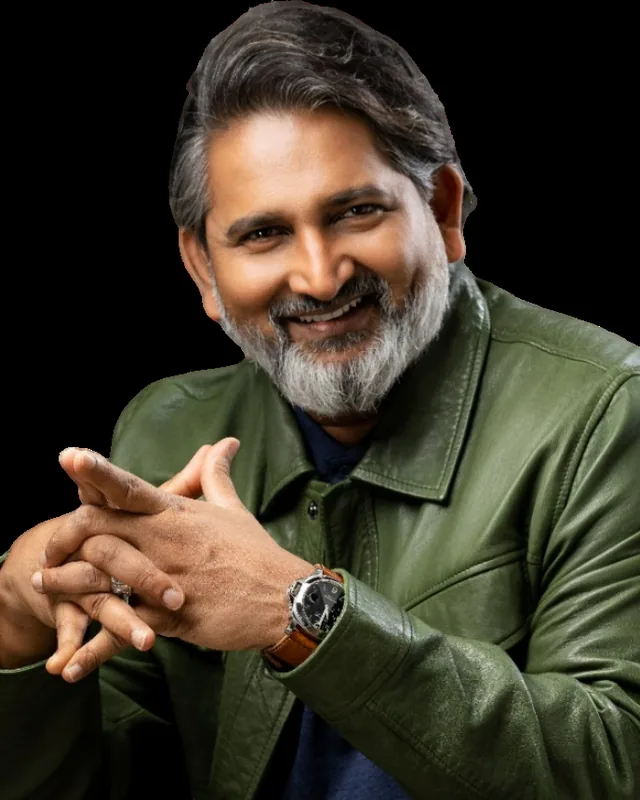
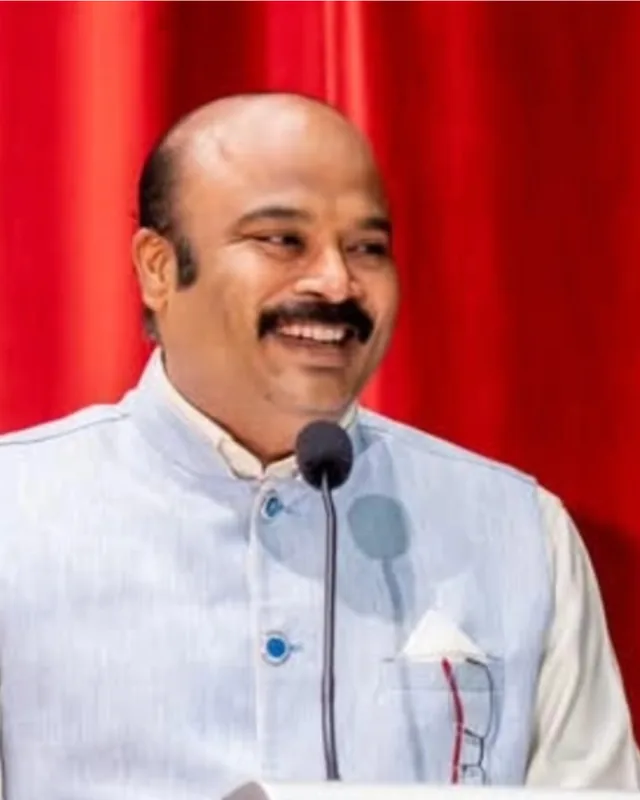
Mr Dinesh Vasu Dash

Foreword

Warmest congratulations to ATAM on the third edition of Anandha Kondaattam.

In just three years, Anandha Kondaattam has grown from a performance showcase into a vibrant four-day celebration of culture and community. Beyond its flagship production, the festival now brings people of all backgrounds together through workshops and interactive talks, inviting audiences to experience, learn and participate in our traditional arts.

This year’s theme, “Peace and Harmony”, is a timely reminder of the important role that the arts play in our multicultural Singapore. Traditional folk arts carry the stories, values and identities of our communities, while also providing a shared language across cultures. In Singapore, where diversity is one of our greatest strengths, festivals like Anandha Kondaattam remind us that we can celebrate our unique traditions while strengthening our shared sense of belonging. This year’s production brings together 18 traditional folk art forms from Singapore’s diverse Indian sub-ethnic communities, alongside Malay and Chinese cultural traditions, all brought to life through live music and percussion.

I am especially heartened that youths make up more than 80 per cent of this year’s nearly 200 participants. Beyond taking to the stage, many have also taken on the responsibility of co-choreographing the performances. Their passion and leadership demonstrate that they are not only carrying these traditions forward but also shaping how they will continue to evolve.

My heartfelt congratulations to ATAM, its partners, volunteers, performers and everyone who has contributed to making Anandha Kondaattam 2026 possible. May this festival continue to inspire more people to discover the richness of our traditional arts, deepen friendships across communities, and strengthen the peace and harmony that define our multicultural Singapore.

I wish everyone a memorable and enriching Anandha Kondaattam 2026.

Mr Dinesh Vasu Dash

Minister of State, Ministry of Culture, Community and Youth &
Ministry of Manpower

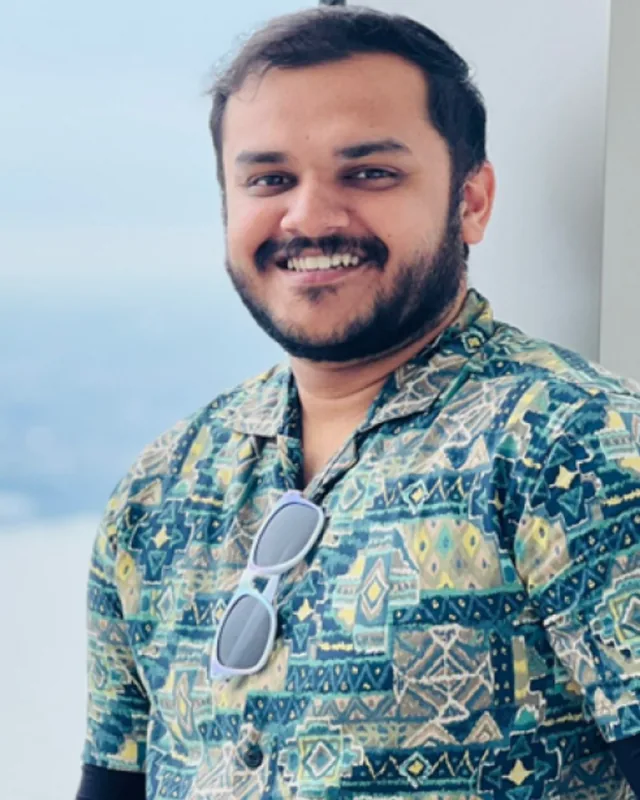
Mr T Raja Segar, Chairman of ATAM

Chairman’s Foreword

The Soul and Beat of Folk Arts

At ATAM, our mission is grounded in a deep-seated reverence for our collective roots. Long before formal stages and structured arts schools existed, humans came together as tribes and villages through folk arts. It is perhaps the most primal form of human expression, shaped by the contours of the terrain, tuned to the sounds of local animals, and woven with the rhythms of changing seasons. Folk arts carry the raw memory of our ancestors, their stories of migration, their triumphs, joys, and their deepest communal bonds.

Folk arts are a way of being. They define a people. A community owns its folk tradition, cultivates it as an essential part of daily life, and passes it down from generation to generation. Performed collectively, these songs and dances mark every critical stage of human existence, from the celebration of birth to the solemnity of death, through seasonal harvests, religious festivals, and tales of brave conflict and survival.

Yet, while these traditions were nurtured within distinct communities, they were never isolated. There has always been an invisible strand connecting them across geographic and cultural divides. The beat of the drums echoes in civilisations across continents. Dance steps may look different yet familiar. Folk art seamlessly moves, adapts, incorporates new environments, and breathes life into new lands. We see this historical fluidity right here in Southeast Asia.

In Singapore, ATAM is actively reviving this powerful tradition by bringing master practitioners of folk arts from India to train local artists in music and dance. We need to carry these traditions into future generations. We are bridging continents and giving our local artists the tools to discover themselves while embedding these timeless traditions into the multicultural fabric of modern Singapore.

With warm regards

Mr T Raja Segar

Chairman, ATAM

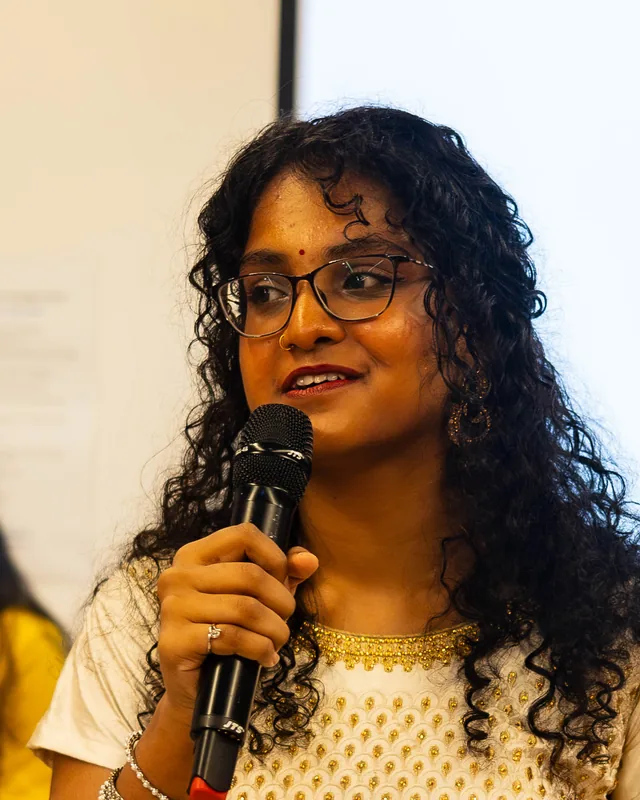
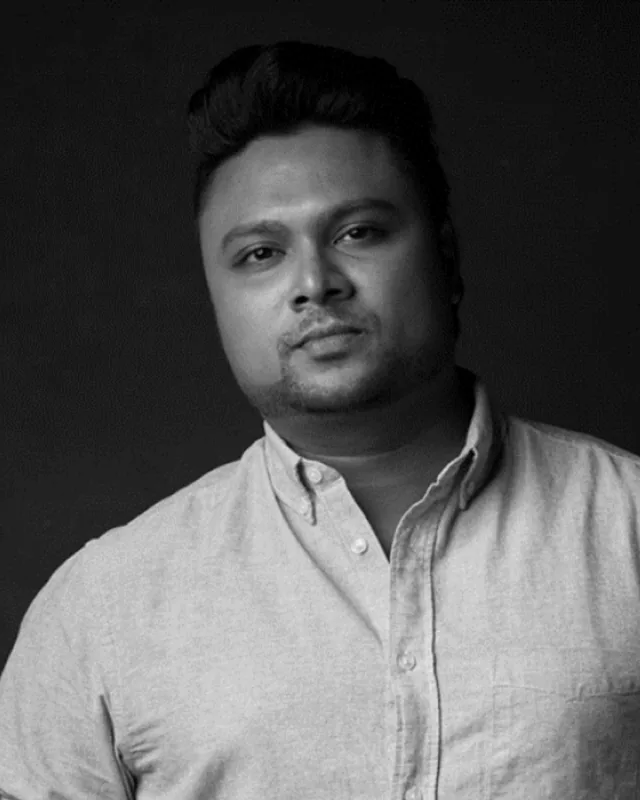
Mr Japhire Gopi Kannan, Founder of ATAM

Founder’s Message

It gives me immense joy to welcome you to Anandha Kondaattam 2026 and to witness the continued growth of ATAM and our traditional folk arts.

Now in our third year, what began as an effort to give traditional folk arts greater visibility is steadily becoming a wider community movement. Through our festivals, workshops and community programmes, we have seen growing interest from people of all ages, especially young people who have embraced these traditions with sincerity and commitment. Many are now progressing beyond participation, pursuing the arts professionally, training with master artistes in India and exploring new collaborations. Their dedication gives us confidence that these traditions will not only survive, but continue to evolve.

The arts have a unique ability to be practised and enjoyed throughout one’s lifetime, allowing children, adults and seniors to participate together and pass on knowledge, memories and lived experience. Heritage arts in particular are born of community and everyday life, and ask little to begin beyond a willing learner and a generous teacher. This accessibility gives them a powerful ability to create belonging and strengthen identity.

Our responsibility is not only to preserve these traditions as memories of the past, but to keep them practised, taught, documented and presented, and to ensure dignity, recognition and sustainable opportunities for the artistes and master practitioners who safeguard this knowledge.

Singapore is widely regarded as one of the safest, most efficient and forward-looking countries in the world. As we progress, we should also strive to become one of the most culturally vibrant, a nation where heritage and the arts are actively celebrated, preserved and passed on. Our aspiration is for Singapore to become a regional, and eventually global, epicentre for heritage arts, where practitioners gather, traditions are exchanged and young artistes are developed without losing the authenticity of the art forms.

We have begun this journey, and the progress made over the past three years would not have been possible without the collective support of our community. ATAM attaining charity status is another important milestone, reflecting our commitment to genuine service, responsible stewardship and good governance.

My heartfelt appreciation goes to the government agencies, cultural institutions, donors, partners, sponsors, volunteers, the families of our artistes, the ATAM team and, most importantly, the artistes and teachers who continue to share their knowledge so generously.

Together, let us ensure that our heritage is not only remembered, but lived; not only protected, but strengthened; and not only inherited, but proudly passed on.

Mr Japhire Gopi Kannan

Founder, ATAM & Anandha Kondaattam

Chapter 02

Who We Are

ATAM Ltd is a non-profit organisation set up in November 2023, and has been granted charity status in Singapore with effect from 31 March 2026. It is dedicated to celebrating traditional folk arts with a special focus on Indian cultural heritage in Singapore. We believe that traditional arts are living expressions that bring people together, strengthening community bonds and fostering cross-cultural understanding.

The ATAM identity mark
  • Mission and Vision

    ATAM is devoted not just to performance, but to the living, breathing transmission of culture - ensuring traditional knowledge is honoured and shared across generations and communities.

    ATAM is committed to protect, promote, and preserve traditional folk arts, with a key focus on integrating communities.

  • Mr T Raja Segar

    Mr T Raja Segar

    Chairman, Advisory Board, ATAM

  • Mr R Rajaram

    Mr R Rajaram

    Advisory Board Member, ATAM

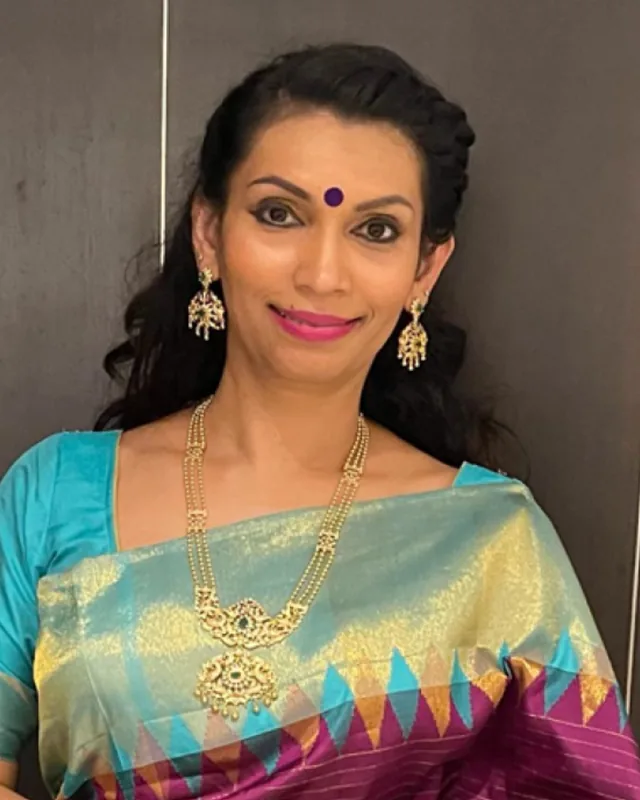
  • Ms Akila Iyengar

    Ms Akila Iyengar

    Advisory Board Member, ATAM

  • Ms Bhavani Selva Kumar

    Ms Bhavani Selva Kumar

    Advisory Board Member, ATAM

  • Mr N Mammathu

    Mr N Mammathu

    Advisory Board Member, ATAM

  • Mr Arumai Chandran

    Mr Arumai Chandran

    Advisory Board Member, ATAM

  • Mrs Jessica Parthiban

    Mrs Jessica Parthiban

    Advisory Board Member, ATAM

  • Mr Japhire Gopi Kannan

    Mr Japhire Gopi Kannan

    Advisory Board Member, ATAM

  • Mr Subbu Adaikalavan

    Mr Subbu Adaikalavan

    Advisory Board Member, ATAM

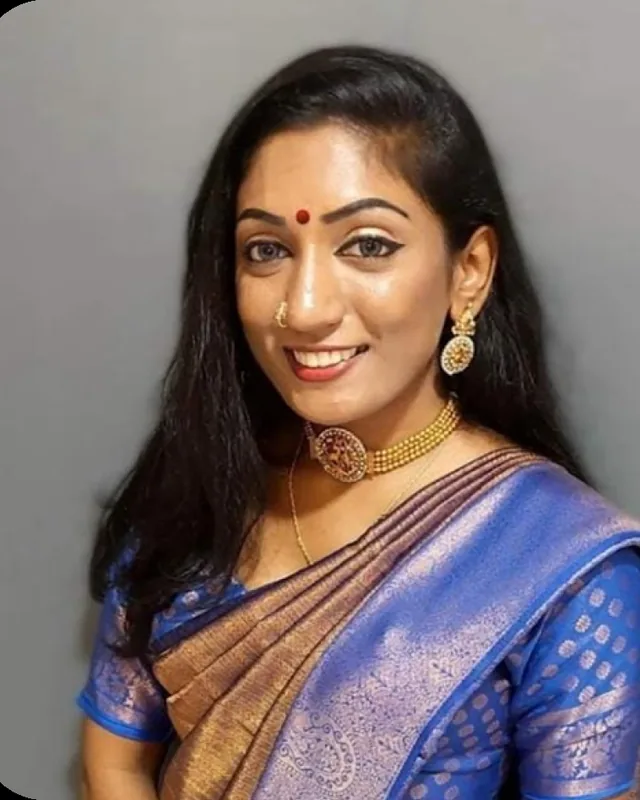
  • Ms Vishnu Vardni Anandan

    Ms Vishnu Vardni Anandan

    Chief Executive Officer

  • Ms Logeshwari Durairaj

    Ms Logeshwari Durairaj

    Head, Outreach & Partnership

  • Mr SRS Maheshwaran

    Mr SRS Maheshwaran

    Treasurer & Head, Knowledge Management

  • Mrs Selvarajeswari Ashok Prabhu

    Mrs Selvarajeswari Ashok Prabhu

    Assistant Head, Outreach & Partnership

  • Mr Anbu Navin N Annadurai

    Mr Anbu Navin N Annadurai

    Head, Public Relations

  • Ms Anumitha Murugapandian

    Ms Anumitha Murugapandian

    Head, Publicity

  • Ms Aathira Unnithan

    Ms Aathira Unnithan

    Head, Donor & Corporate Relations

  • Mr Aaqil Mohamed Bilal

    Mr Aaqil Mohamed Bilal

    Secretary

  • Mr Lionell Heeran Raj

    Mr Lionell Heeran Raj

    Manager, Operations

  • Ms M Bhagavathi

    Ms M Bhagavathi

    Treasurer

  • Mr Subbiah Sarvanan Kasi

    Mr Subbiah Sarvanan Kasi

    Head, Digital Content

Swipe to follow the timeline →

  1. 2026

    The ATAM Connect identity mark

    ATAM Connect launches

    A unified platform bringing together arts, culture and heritage events, workshops and performances across Singapore.

  2. 2026

    ATAM's identity mark, marking its charity status

    ATAM is granted charity status

    A milestone in the organisation’s commitment to genuine service, responsible stewardship and good governance.

  3. 2026

    Therukoothu performers in costume during the masterclass showcase

    Nam Marabu Series 2026

    • 5 editions
    • 1,400+ participants
    • 23 institutions

    Five months, five art forms, closing with a five-day Therukoothu masterclass. The gallery is below.

  4. 2026

    Percussionists at the Singapore HeritageFest opening

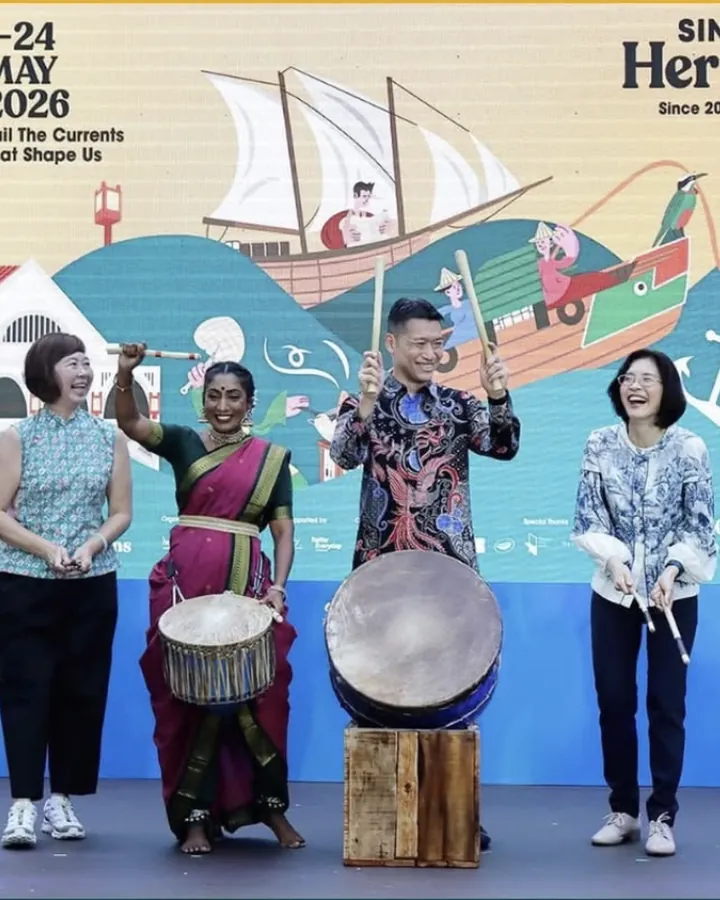
    Singapore HeritageFest opening

    ATAM curated the opening act. Mr David Neo, Minister for Culture, Community and Youth and Second Minister for Education, inaugurated the festival by striking the Thudumbu.

  5. 2025

    The finale of Anandha Kondaattam 2025 on stage

    Anandha Kondaattam, second edition

    • 13,500 over two nights
    • 265 artistes and crew
    • 27 arts groups
    • 80% youth

    Graced by Prime Minister Lawrence Wong and Minister of State for Manpower and Ministry of Culture, Community and Youth Dinesh Vasu Dash, who participated in the finale as Thudumbu drummers.

  6. 2025

    A Nam Marabu Series 2025 session in progress

    Nam Marabu Series 2025

    The second iteration, again with the Indian Heritage Centre.

  7. 2025

    Traditional arts group leaders at ATAM's engagement session

    Indian Traditional Arts Engagement Session

    ATAM's inaugural gathering of traditional arts group leaders, convened to strengthen the ecosystem around them.

  8. 2024

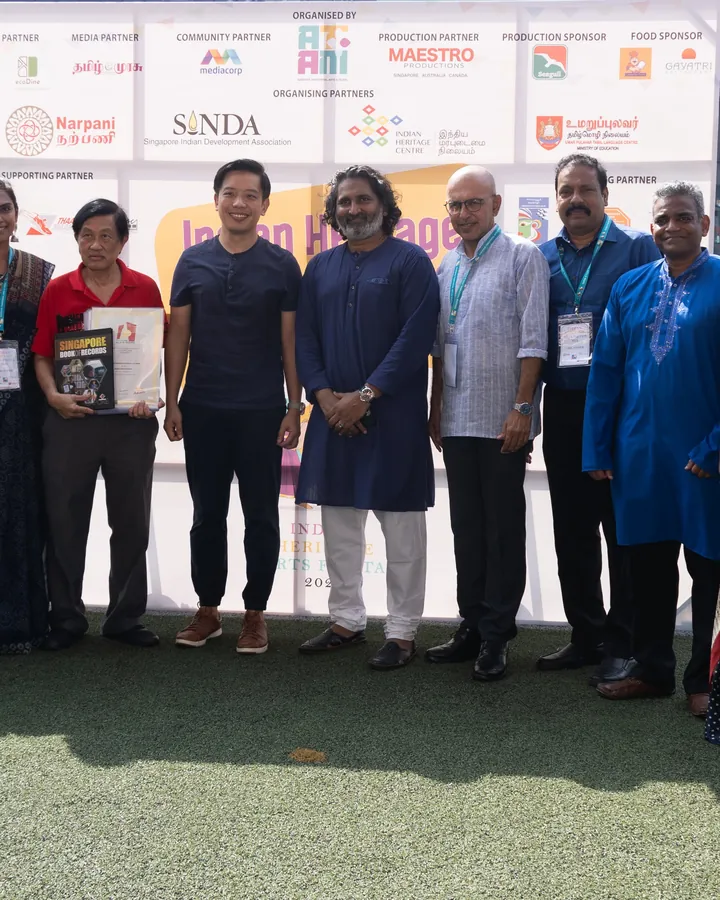
    Participants and guests at the Indian Heritage Arts Fiesta

    Indian Heritage Arts Fiesta

    • 1,000+ participants
    • 2 national records

    Largest Mass Kolaattam Dance and Largest Medley of Indian Traditional Percussion, both entered in the Singapore Book of Records.

  9. 2024

    A master artiste leading a Nam Marabu Series session

    Nam Marabu Series begins

    • 12 art forms
    • 19 master artisans

    ATAM’s flagship educational programme opens, run with the Indian Heritage Centre.

  10. 2024

    The company of Anandha Kondaattam 2024 on stage

    Anandha Kondaattam, first edition

    • 18,000 in person
    • 6,000 on livestream
    • 200+ artists

    Honoured by Tamil Nadu Member of Parliament Mrs Kanimozhi Karunanidhi.

  11. Ongoing

    Stills from ATAM's digital archive of folk arts

    Building a digital archive

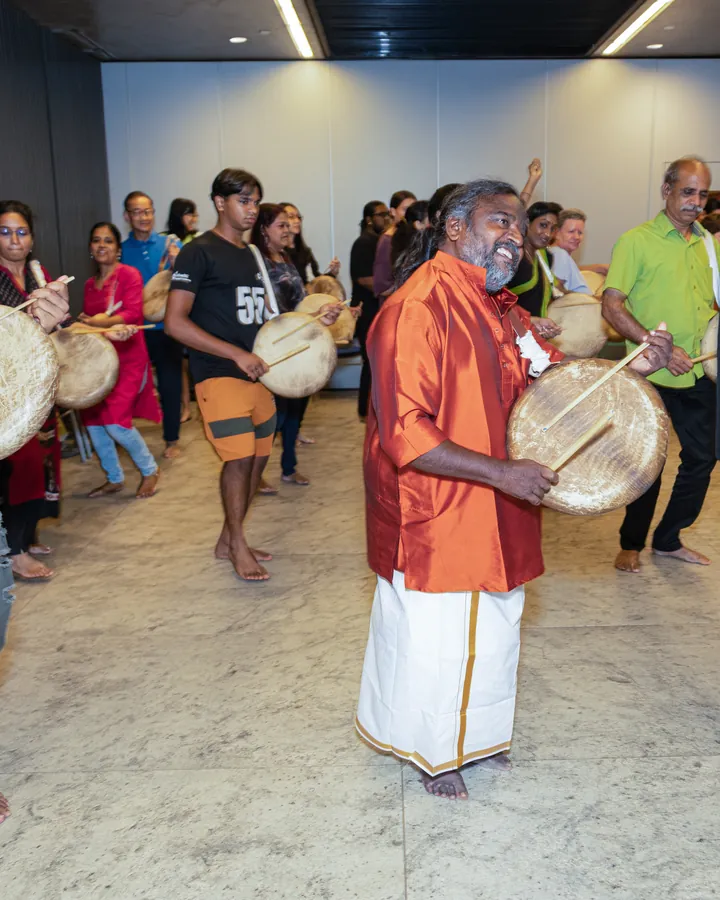
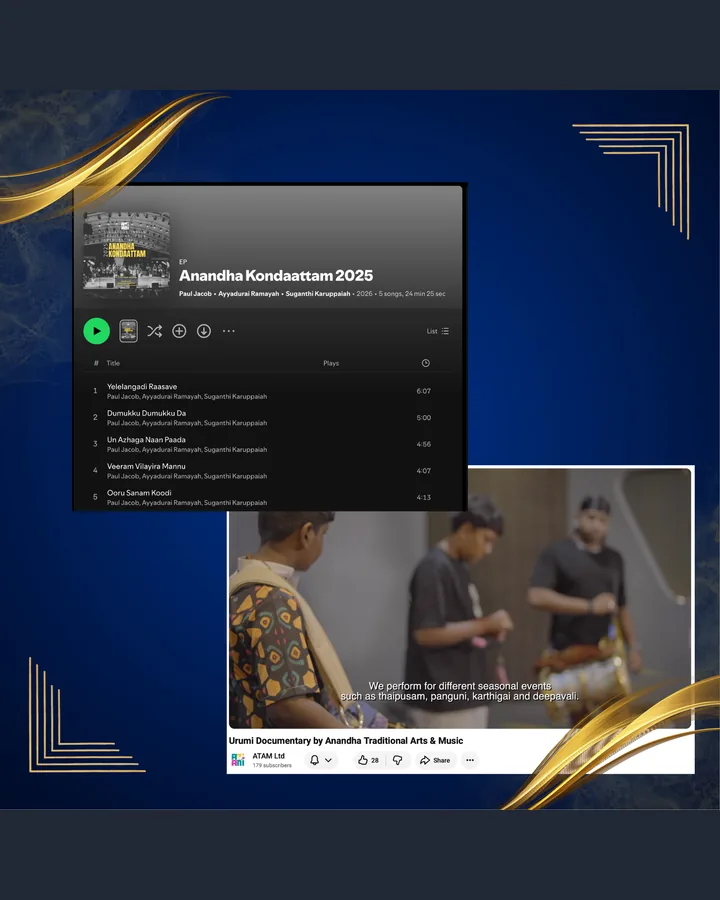
    Digital archiving efforts feature Spotify releases of original folk songs and cultural documentaries, including the Urumi documentary selected for the Tamil Nadu Film Festival and a new Therukoothu feature.

Nam Marabu Series 2026 · five editions

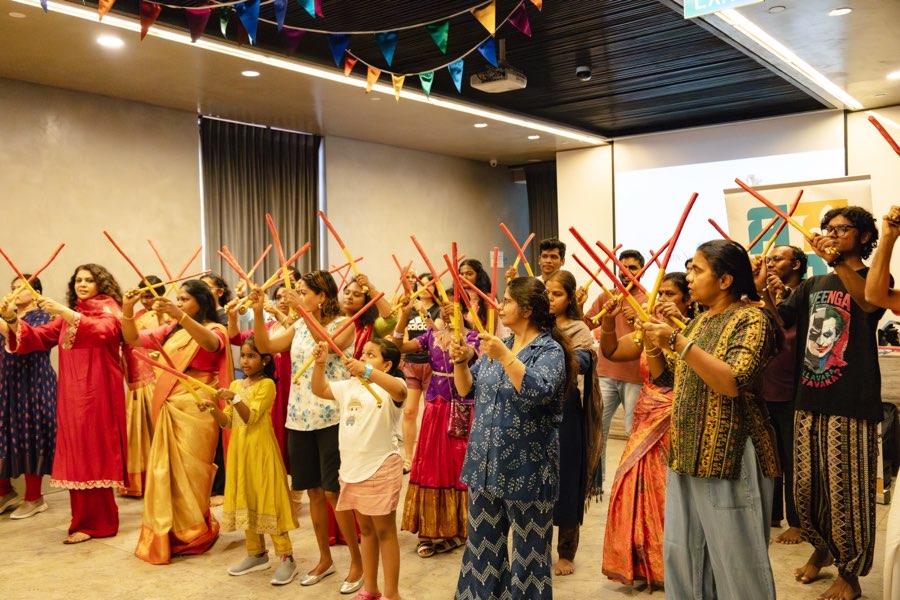
Salangai Kittiyattam

Conducted by Master Artist Mr Gopi Arumugam, hailing from Thanjavur.

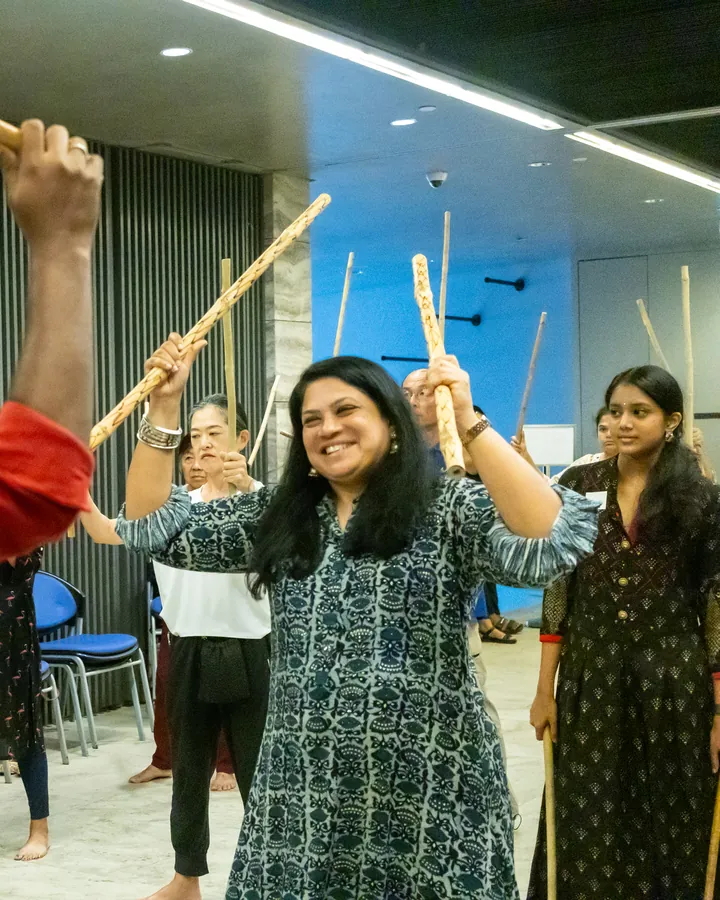
Participants holding salangai kitti sticks after the workshop
Participants raising the sticks in unison during the workshop

Chapter 03

About Anandha Kondaattam 26

Anandha Kondaattam, the Singapore Indian Traditional Folk Arts Festival, is a vibrant and enriching celebration of the diverse folk traditions from the Indian diaspora and other ethnic communities in Singapore.

Anandha Kondaattam in Tamil translates to a “joyous celebration”, while our logo features silhouettes of the various traditional Indian folk art forms. Presented in collaboration with Esplanade – Theatres on the Bay, the festival offers an international platform that showcases and honours Singapore’s rich multicultural tapestry.

At A Glance

  • 18+Unique art forms
  • 200+Artists
  • 80%Youth involvement
  • 30,000+Live audiences over 2024 and 2025

The Vision

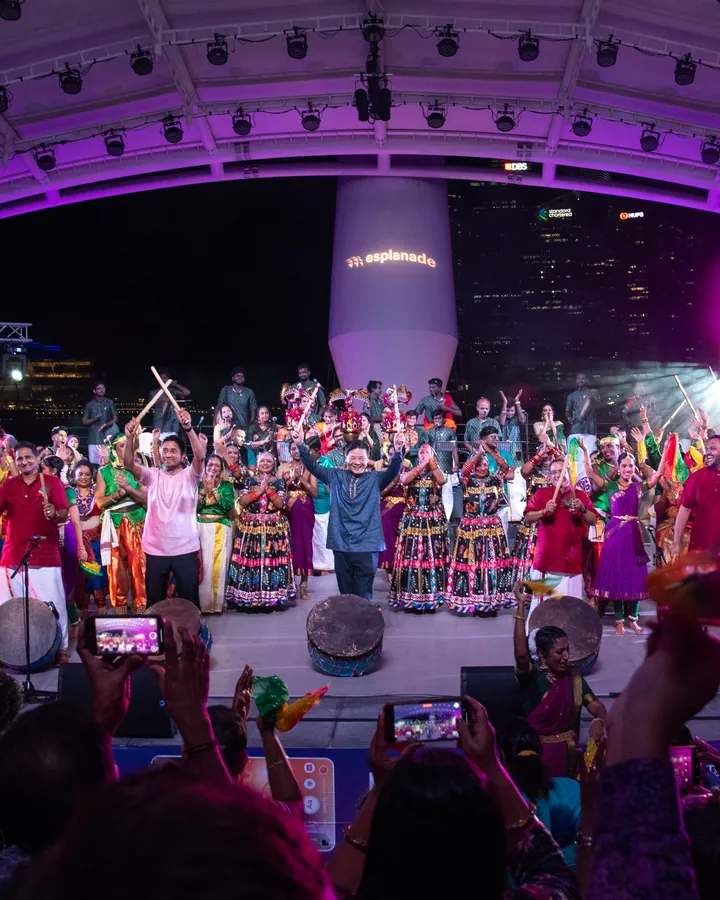
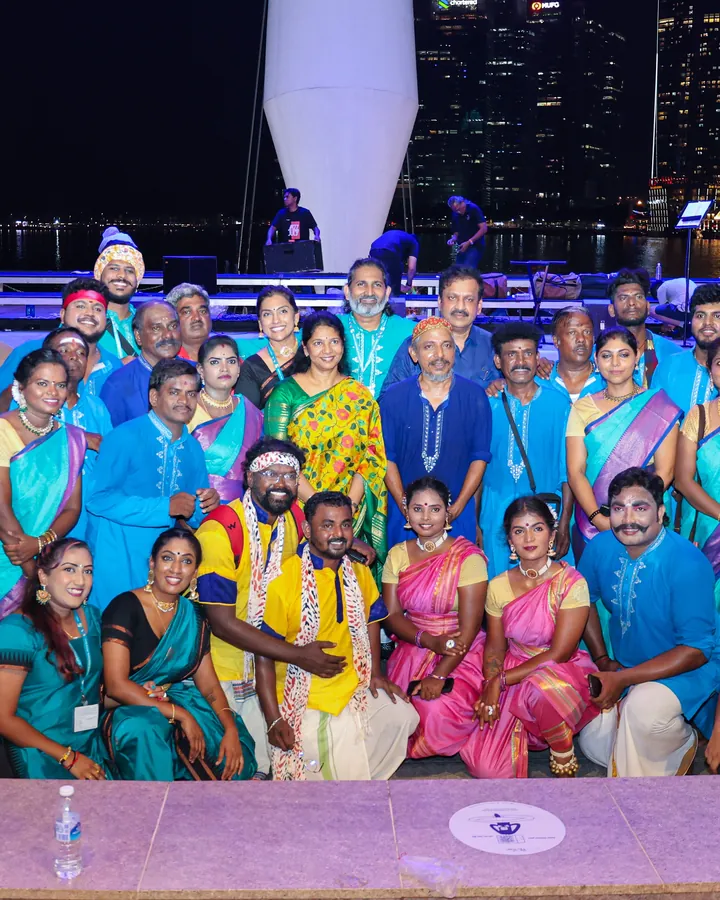
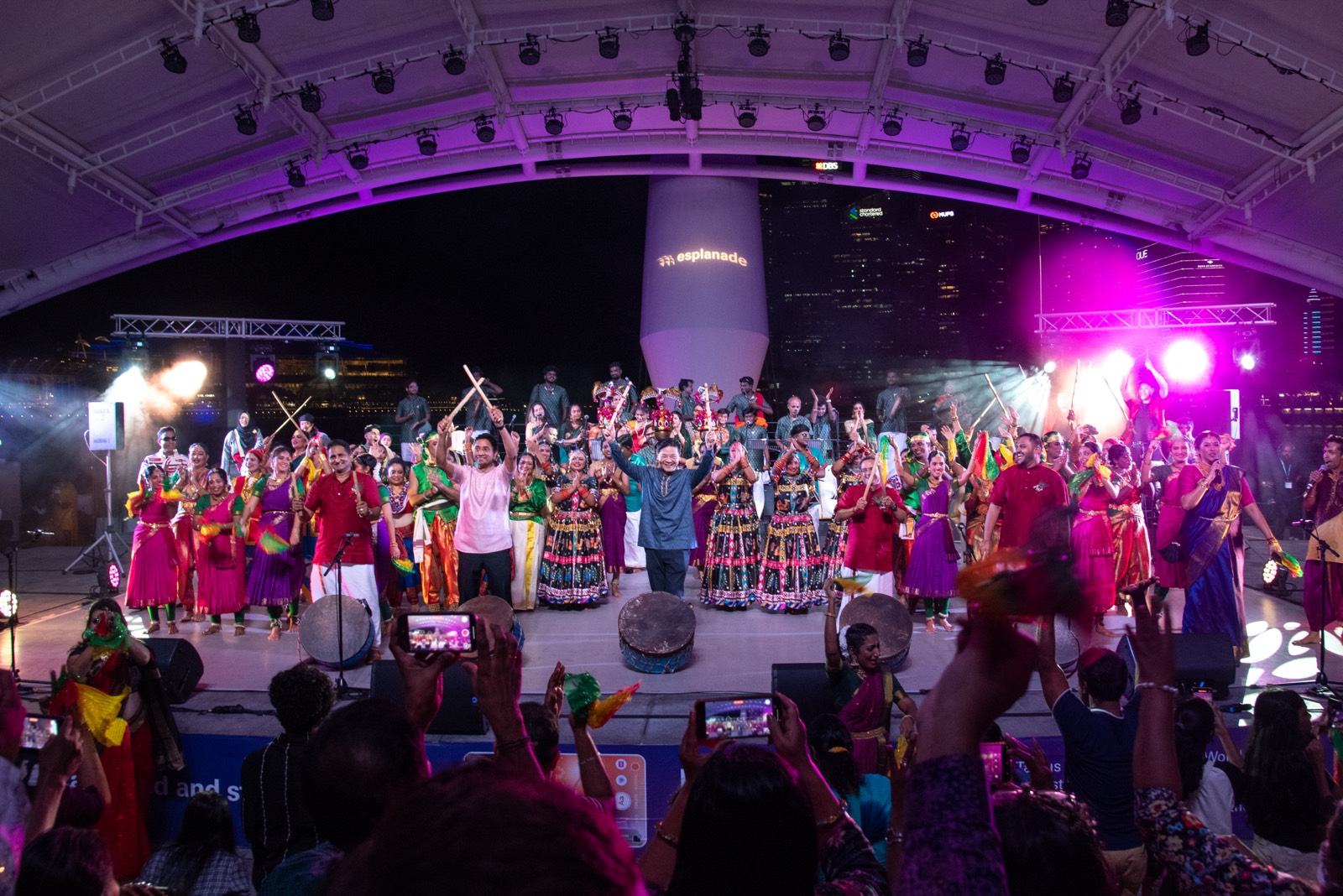
The full ensemble on stage at the Esplanade Outdoor Theatre, audience in the foreground
  1. 01Artistic Expression
  2. 02Youth in Arts
  3. 03Community Engagement
  4. 04Cultural Tourism
  5. 05Multiculturalism
  1. 01

    Artistic Expression

    Traditional folk arts offer a unique canvas for creativity, allowing artists to honour their heritage while engaging with contemporary themes, ensuring relevance across generations.

  2. 02

    Youth in Arts

    Over 80% of our participants are youths under the age of 35. This year, watch some of their co-creations and choreographies come to life on the grand stage.

  3. 03

    Community Engagement

    The festival fosters grassroots participation, bringing together artists, audiences, and community groups. This active engagement helps keep traditions alive and strengthens communal bonds.

  4. 04

    Cultural Tourism

    By spotlighting Indian folk arts on a global stage, the festival enhances Singapore’s position as a cultural destination, drawing visitors eager to explore the richness of traditional artistry.

  5. 05

    Multiculturalism

    In a culturally diverse nation like Singapore, festivals such as Anandha Kondaattam play a crucial role in promoting mutual respect and intercultural dialogue, contributing to social cohesion.

Our Theme: Weaving Peace & Harmony

Anandha Kondaattam 2026 explores these two salient themes through its intentional cross-cultural collaborations, thoughtfully penned lyrics and through the unifying nature of the art forms themselves.

The Animal

Each of the three traditions has a dance where the performer takes on an animal.

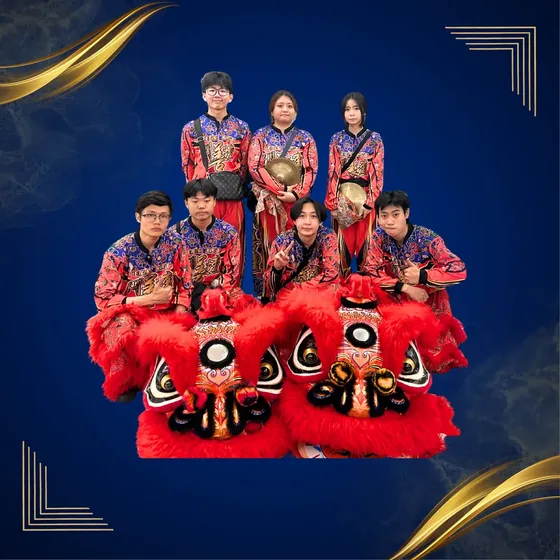
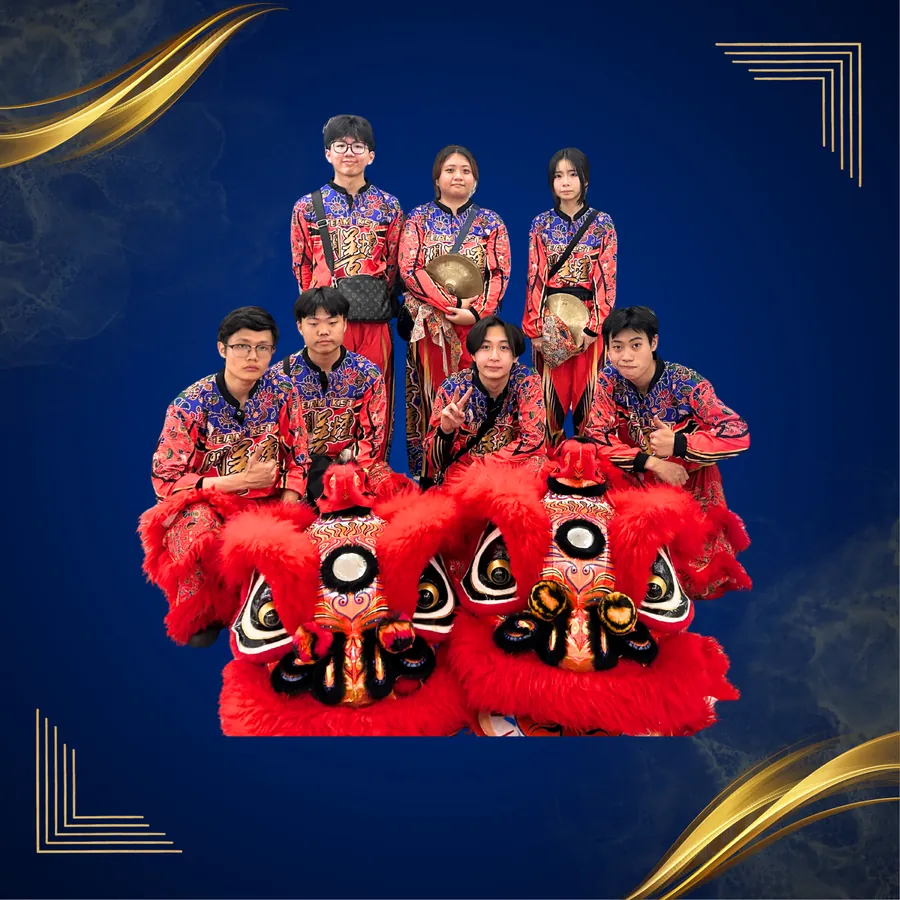
  • Lion Dance
    Lion Dance

    Chinese

    Two performers share one lion.

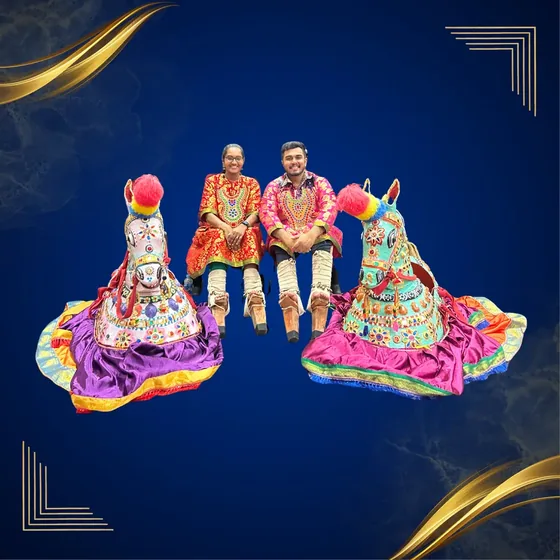
  • Poikkaal Kuthirai

    பொய்க்கால் குதிரை

    Poikkaal Kuthirai

    Tamil

    A false-legged horse worn at the waist.

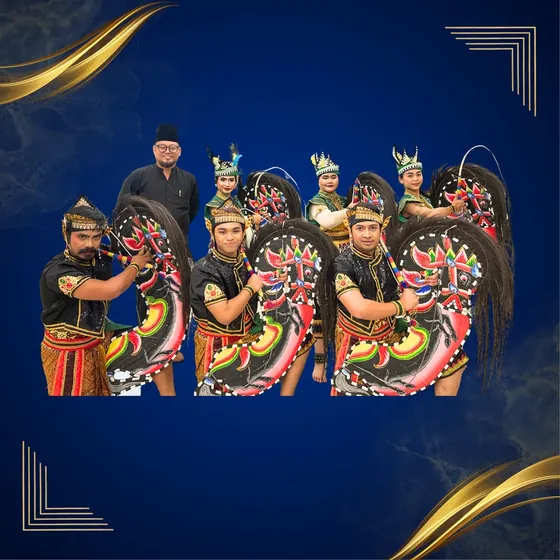
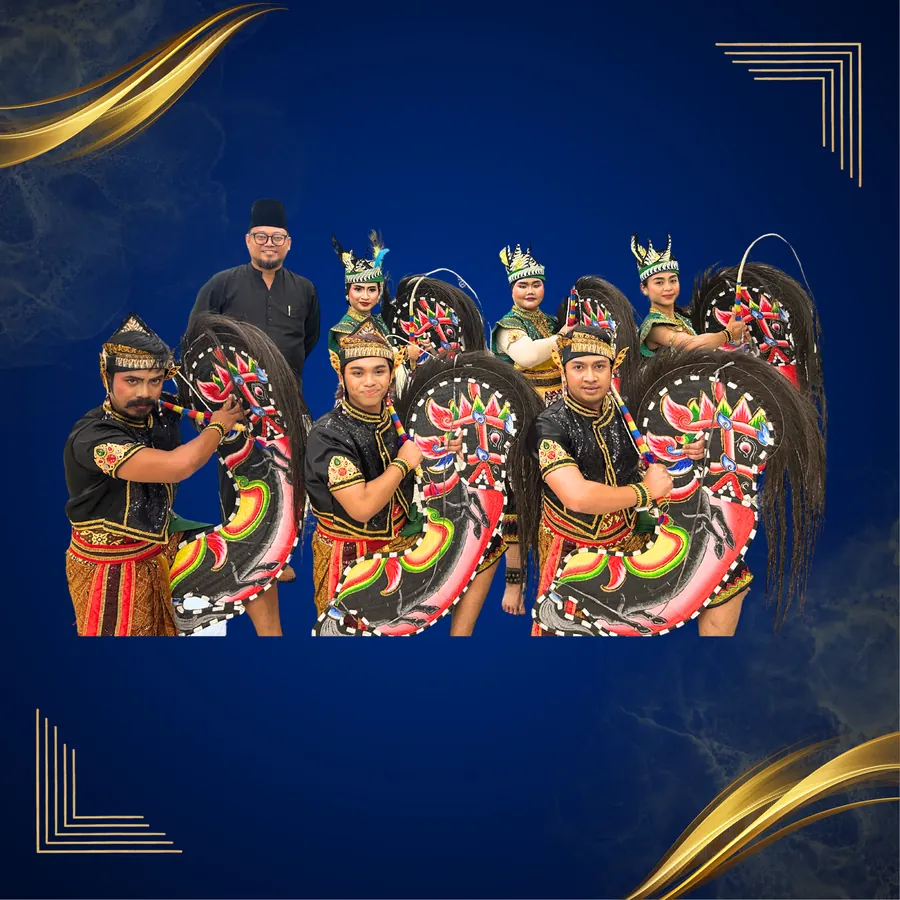
  • Kuda Kepang
    Kuda Kepang

    Malay

    A flat horse figure, straddled by the dancer.

Three Drums, One Voice

Each brings its own drum, and on the night they are played together.

  • Bian Gu and Xian Gu
    Bian Gu & Xian Gu

    Chinese

    A single-headed frame drum, struck with sticks.

  • Urumi, Parai and Thavil

    உறுமி · பறை · தவில்

    Urumi · Parai · Thavil

    Tamil

    Three drums, three voices.

  • Kendang
    Kendang

    Malay

    A two-headed drum, played with the hands.

What’s New

Pre Festival

This year, Anandha Kondaattam is a four-day festival ecosystem culminating in our milestone stage production. Three evenings led to today.

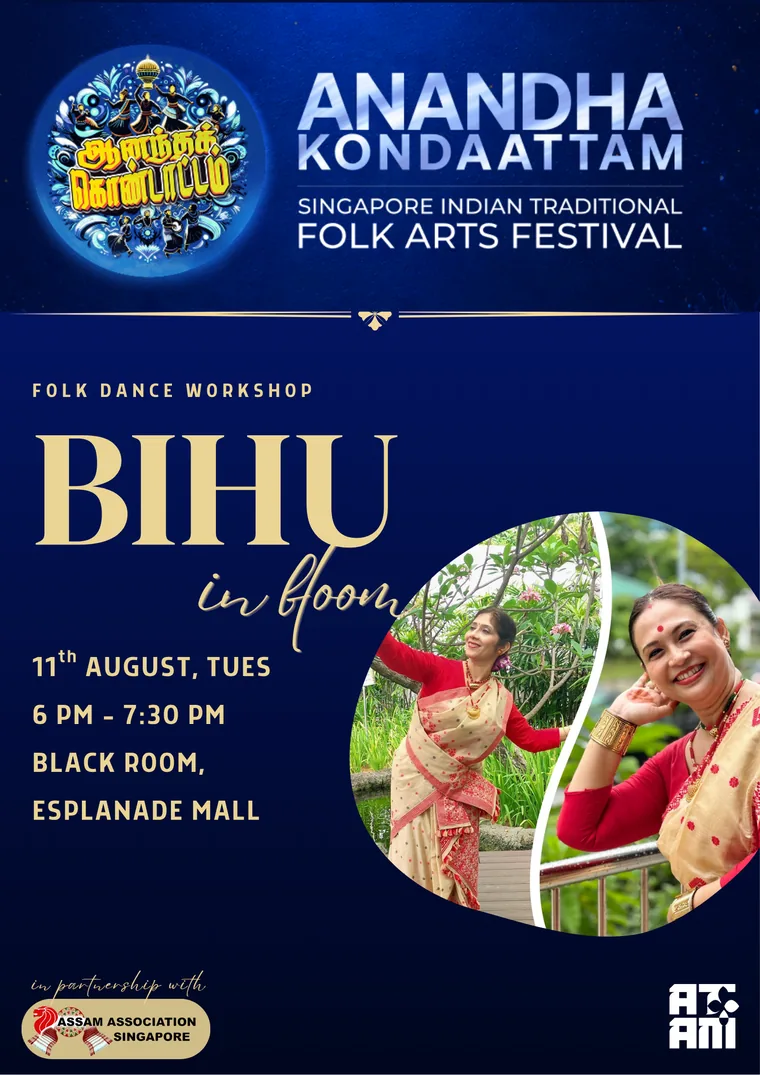
  • Poster for Bihu in Bloom

    Bihu in Bloom

    Folk dance workshop
    11 August · Esplanade Mall

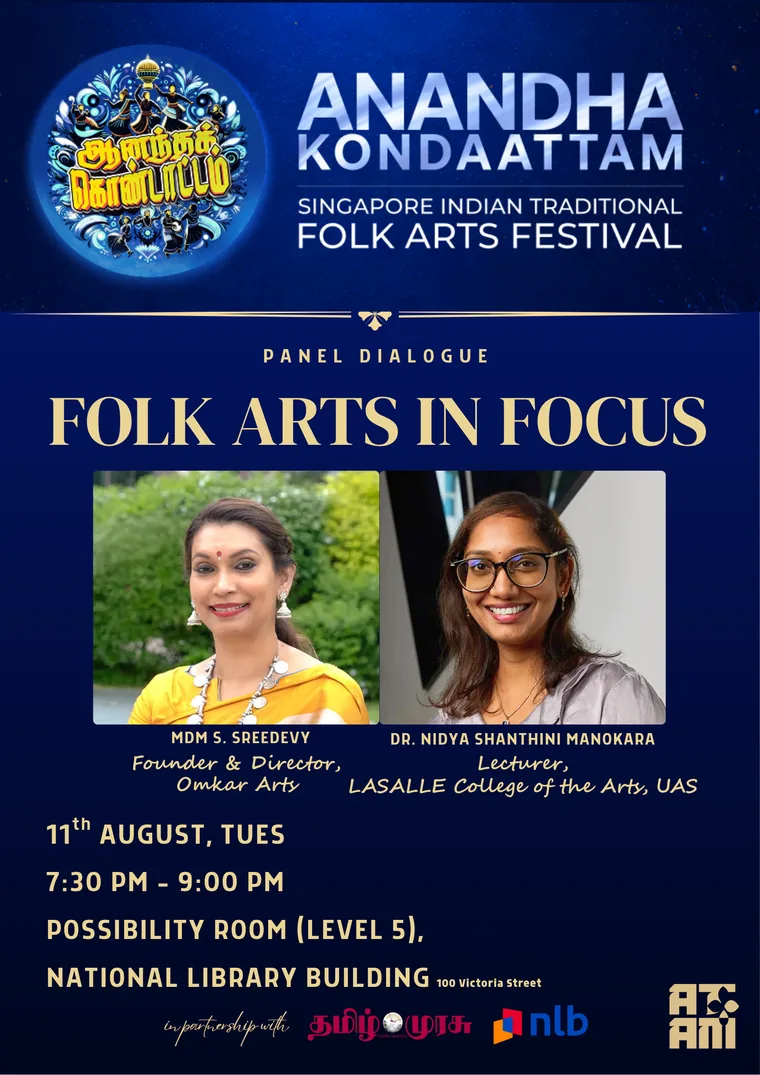
  • Poster for Folk Arts in Focus

    Folk Arts in Focus

    Panel dialogue
    11 August · National Library

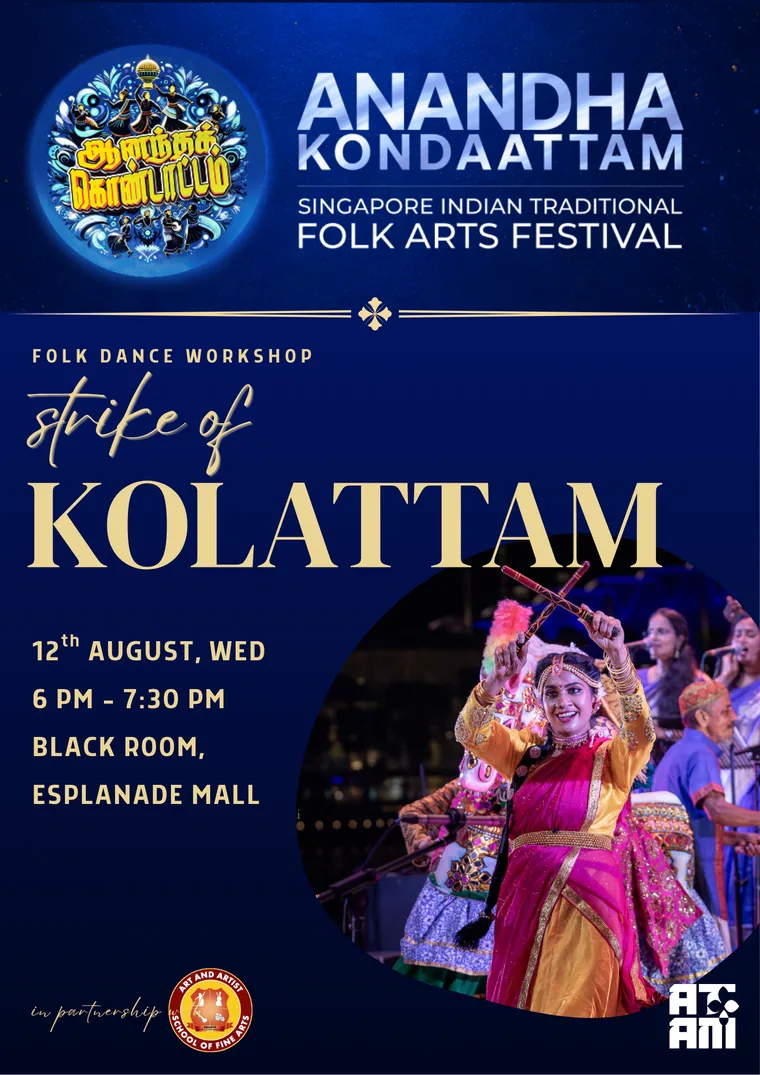
  • Poster for Strike of Kolattam

    Strike of Kolattam

    Folk dance workshop
    12 August · Esplanade Mall

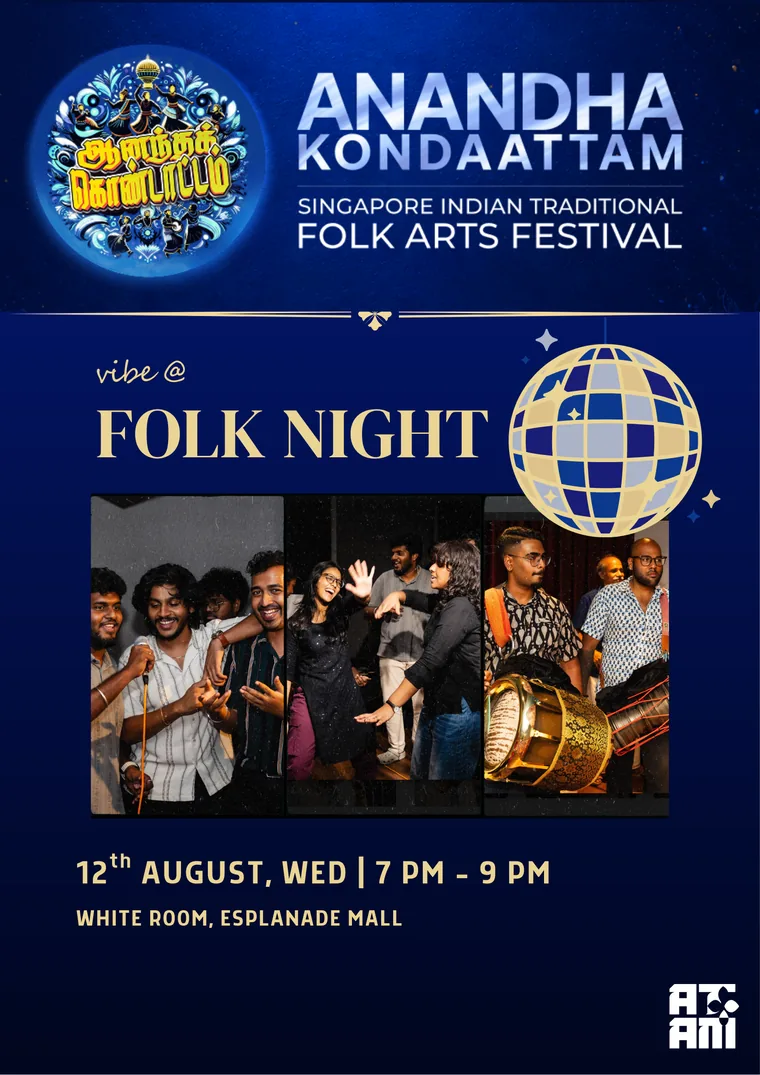
  • Poster for Folk Night

    Folk Night

    Open floor
    12 August · Esplanade Mall

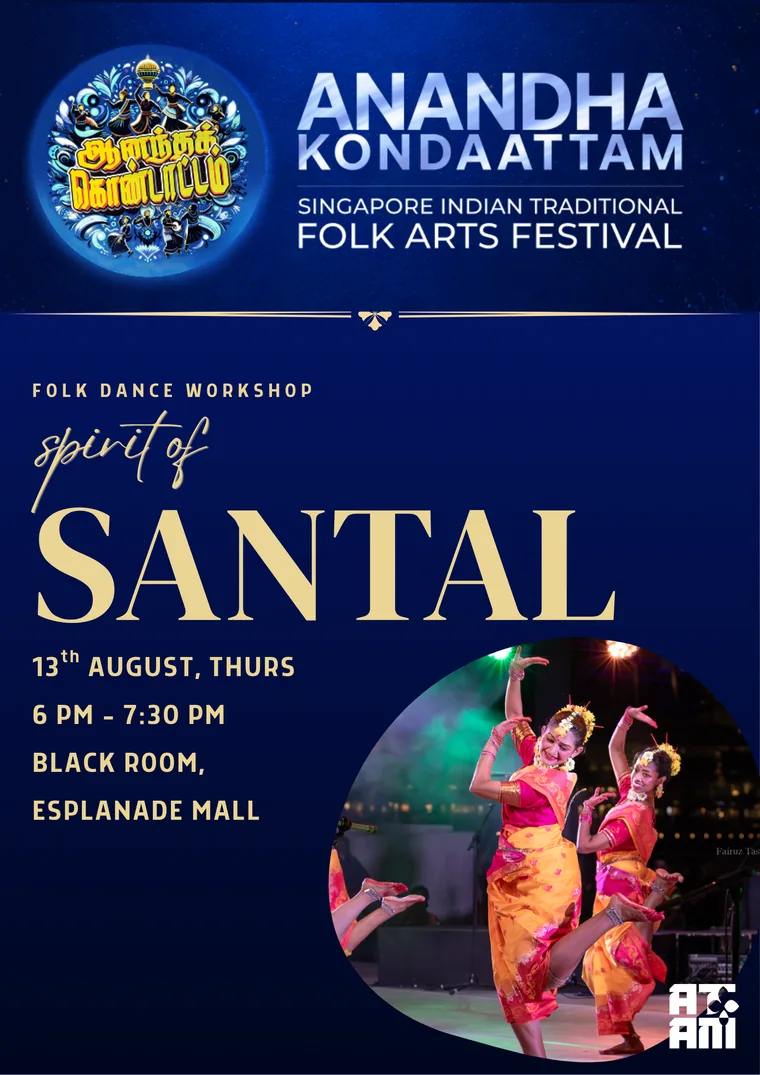
  • Poster for Spirit of Santal

    Spirit of Santal

    Folk dance workshop
    13 August · Esplanade Mall

Bihu in Bloom

On 11th August, Tuesday, the festival kicked off with an engaging folk dance workshop titled “Bihu in Bloom.” Our master trainers led participants through the vibrant steps of the historical Bihu dance from Assam, bringing its rich traditions to life.

Folk Arts in Focus

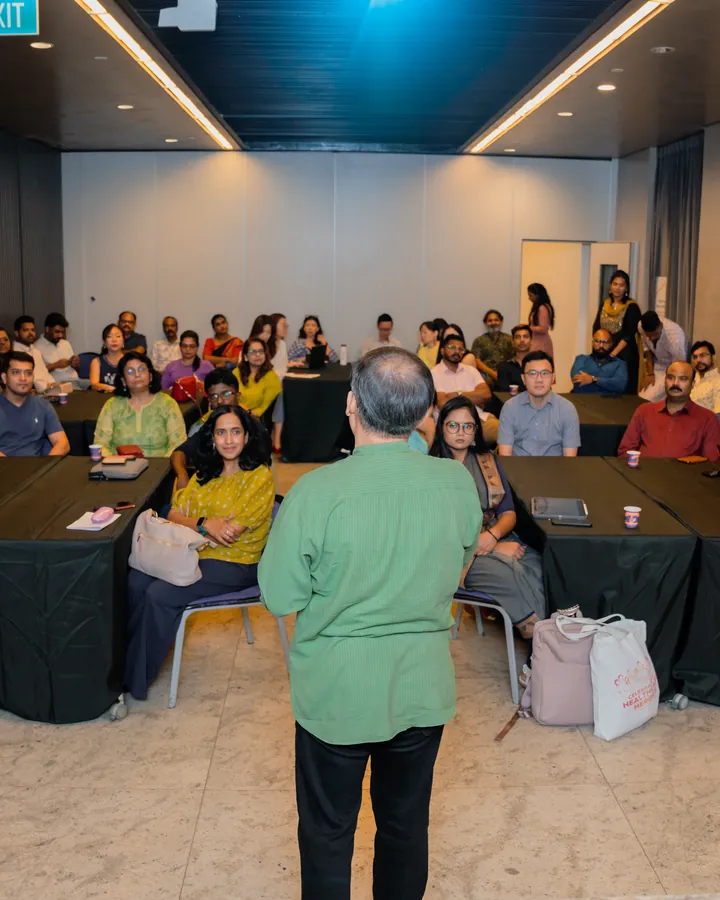
Following the lively workshop on 11th August, an insightful panel dialogue titled “Folk Arts in Focus” took place. The discussion brought together experts Mdm Sreedevy, Founder & Director of Omkar Arts, and Dr. Nidya Shanthini Manokaran, Lecturer at LASALLE College of the Arts, UAL, for a deep dive into the world of traditional arts.

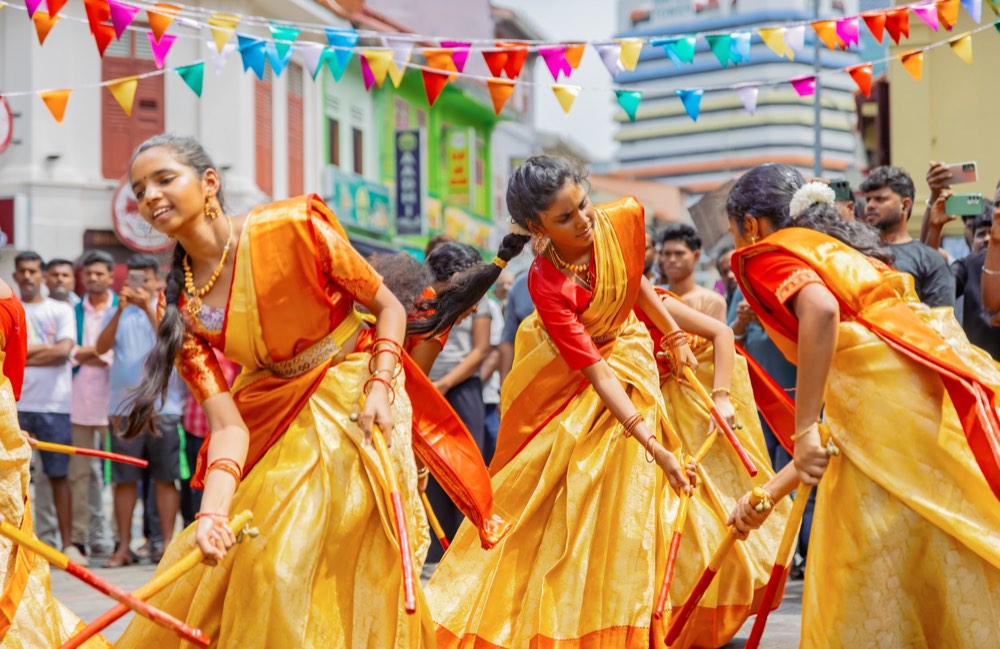
Strike of Kolattam

On 12th August, Wednesday, the energy continued with another dynamic folk dance workshop, “Strike of Kolattam.” Participants were introduced to the rhythmic beats and spirited movements of the traditional Kolattam stick dance.

Folk Night

Later that evening on 12th August, the “vibe @ FOLK NIGHT” provided an open floor for celebration, bringing everyone together with a lively performance featuring the band Aarpo.

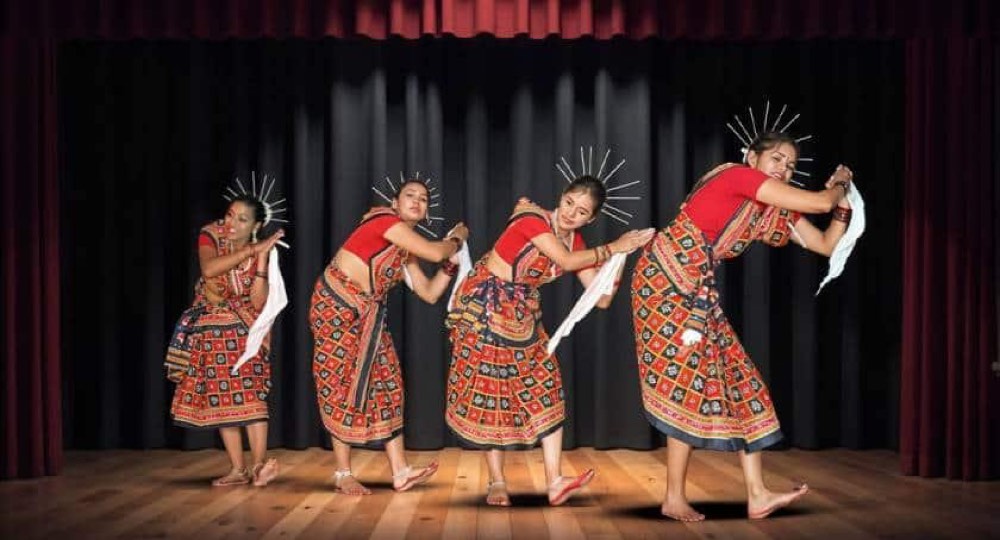
Spirit of Santal

On 13th August, Thursday, the festival carried on its joyous momentum with the “Spirit of Santal” folk dance workshop, where participants could immerse themselves in the lively and expressive Santal dance.

Chapter 04

The People Behind the Festival

Festival Team

  • Ms K Jayaprema

    Ms K Jayaprema

    Festival Producer

  • Mr R Venga

    Mr R Venga

    Director

  • Mr Paul Jacob

    Mr Paul Jacob

    Music Director

  • Ms Logeshwari Durairaj

    Ms Logeshwari Durairaj

    Dance Director

  • Mrs Swarna Varsha Gurumoorthy

    Mrs Swarna Varsha Gurumoorthy

    Assistant Dance Director

  • Mr Vivek Bharathi

    Mr Vivek Bharathi

    Lyricist

  • Mr Karthikeyan Subramanian

    Mr Karthikeyan Subramanian

    Story & Screenplay

  • Mr SRS Maheshwaran

    Mr SRS Maheshwaran

    Scriptwriter

  • Ms Geja Shreya Rajkumar

    Ms Geja Shreya Rajkumar

    Production Assistant

  • Ms Sabarna Manoharan

    Ms Sabarna Manoharan

    Production Assistant

  • Associate Music Coordinator

    Anand Dhamelia

  • Lighting Personnel

    Nagaraj (David)

  • Audio Engineer

    Durairaj Arockia Jeyaraj

  • Pre-Festival Coordinator

    Ms Aathira Unnithan

  • Media Liaison

    Mr Anbu Navin N Annadurai

  • Publicity and Marketing Coordinator

    Ms M Bhagavathi
    Ms Anumitha Murugapandian

  • Website Updates

    Mr Subbiah Saravanan

  • Volunteer Management

    Mr Aaqil Mohamed Bilal

  • Ms Vishnu Vardni Anandan

    Ms Vishnu Vardni Anandan

    Project Head

  • Mr T Raja Segar

    Mr T Raja Segar

    Festival Advisor

  • Ms Bhavani Selva Kumar

    Ms Bhavani Selva Kumar

    Festival Advisor

  • Mr Subbu Adaikalavan

    Mr Subbu Adaikalavan

    Festival Advisor

  • Mr Japhire Gopi Kannan

    Mr Japhire Gopi Kannan

    Festival Advisor

  • Mdm Sreedevy

    Mdm Sreedevy

    Choreography Advisor

  • Dr Elavazhagan Murugan

    Dr Elavazhagan Murugan

    Script Advisor

  • Mr Karthikeyan Somasundaram

    Mr Karthikeyan Somasundaram

    Creative Advisor

Musicians

  • Akash Sankar
  • Anand Dhamelia
  • Anandhi Jagan
  • Danushkodi Tamilselvam
  • Gunaseelan Muniyandi
  • Gurunathan Muthukannu
  • Inbaraj Yesudas
  • Jagan Jayabalan
  • Kabildeva Sundaram
  • Murugesan Munish Jayaram
  • Paul Jacob
  • Prasanna Prabhakaran
  • Prema Lakshmi Rangaraj
  • Ramesh Shanmugam
  • Sangeeta D/O Tamilarasan
  • Sarva Srilal Tejasvini
  • Suganthi Karuppaiah
  • Suguna Mathiyalagan
  • Urja Dhamelia
  • Vivek Srinivasan

Artiste Manager

  • Hemanth Kumar Kevalchand

Hosts

  • Dhivyah Raveen Kumar
  • Vishnu S/O Anandhakrishnan

Technical Crew

  • Ganesh Murusamy
  • Harindran Tamilmaran
  • Hemaraaj S/O Amuthan
  • Ipsita Das
  • Molla MD Nadir
  • Murugaprakash S/O Nagaraj
  • Naaraayanan S/O Soma Raamasamy
  • Nanthiniy Gunasegeran
  • Naresh S/O Thiagarajan
  • P Shoban
  • Parthiban S/O Krishnan
  • Ravi S/O Subramanian
  • Robel
  • Selvaraj Ramkumar Sakthi Maheshwaran
  • Sharon Roosevelt
  • Shifat Ahamed
  • Subramanian Karthikeyan
  • Surin
  • Lau Jin Huang
  • Habib Noor (Camera Crew)

Volunteers

  • Amirtha Sivaraman
  • Anand Nethra
  • Bharath Reddy Vanukuru
  • Murugappan Thenammai
  • Naina Mohamed Ramesha Begum
  • Natarajan Aarthi
  • Palappan Jayasudha
  • Prarthana Subramanian
  • Puchikarupiah Kalai Selvan
  • Puvhisha Anand
  • Rajagopal Jayabal
  • Rajasekaran Kobika
  • Ramachandran Ashokkumar
  • Santha D/O Raman
  • Selvam Karthikeyan
  • Hidayadullah Aafrin Neropa
  • Durgamu D/O N Tinagaran
  • Sakthivelu Janani Sruthi
  • Paandi Nadesh
  • Vaishvini Pillai
  • Shivaani D/O Sunthararajan
  • Solai Divya
  • Ganeshkumar Dharshiga
  • Safiyah D/O Shagul Hameed
  • Revathy Appar
  • Lavanya Subramanian

Make-up Artists

  • Aruna Karunanithy
  • Zulhelmi Bin Hasbi
  • Juhainah
  • Sulaiman Bin Bangawan
  • Razinna Binte Mohd Nuri
  • Mohd Khidir Surani
  • Devarasetty Swathi
  • Kalai Selvei Rengasamy
  • Palaniswamy Punithavathi
  • Rashika Rajendran
  • Tharani D/O Vijayan
  • Therampalayam Palanisamy Deepa
  • Vigneswary D/O K Jeganathan

Finance Team

  • Mr Raswinth Ramesh
  • Mr Kovalan
  • Mr Gerard
  • Ms Mashaliza

Technology Team

  • Mr Mathanraj S
  • Mr Vengadeshan Marichamy
  • Mr Vijay Anand

E-Booklet Editors

Ms Vishnu Vardni Anandan & Mr SRS Maheshwaran

Performers

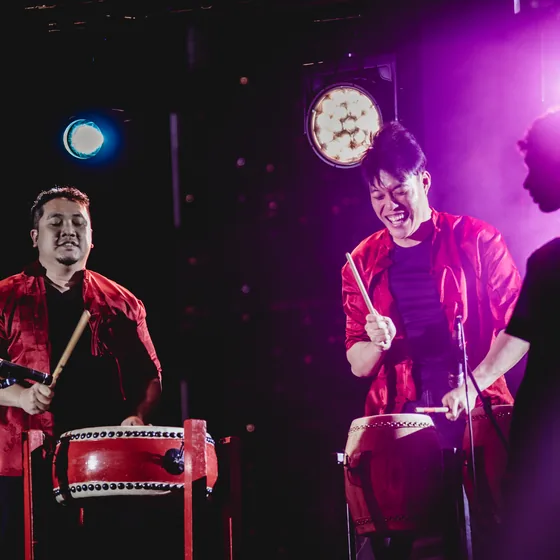
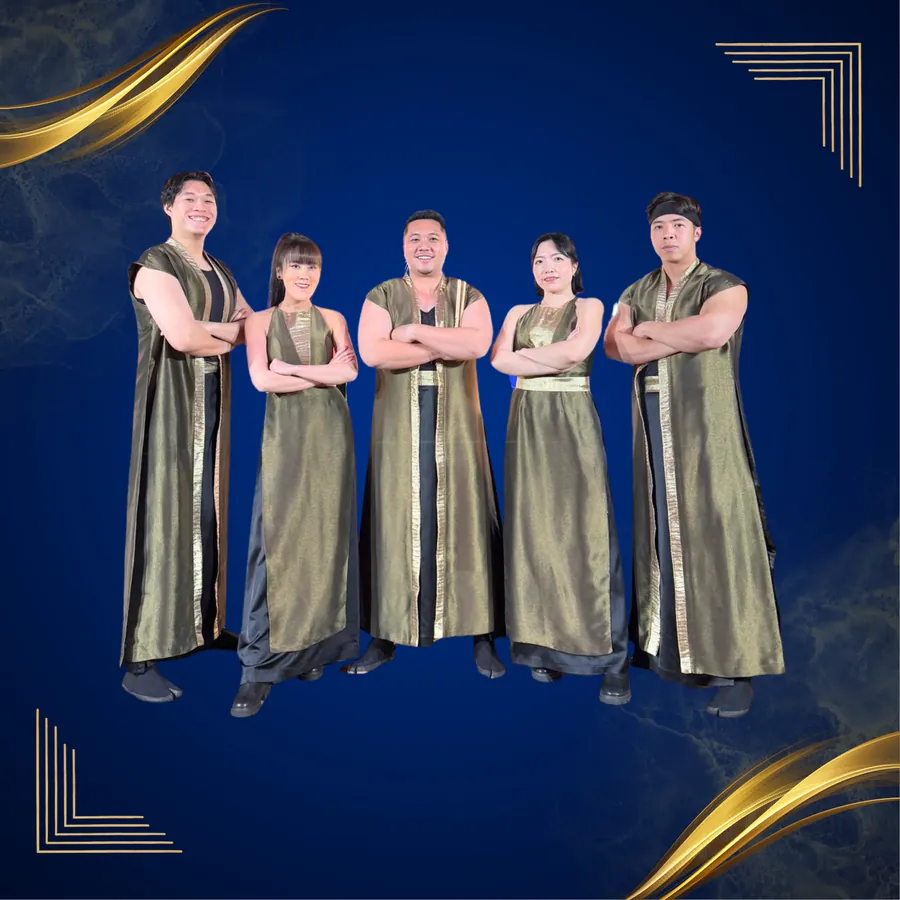
The Chinese Percussion performers

Chinese Percussion

Performed byDrum Feng

Musicians

  • Ng Wei Jie, Glen
  • Lim Wee Yang
  • Teh Kai Yin Cheney

Artist Management

  • Qli Quek Li Hui
  • Jamie Tan Yong Xin
The Dhol Tasha performers

Dhol Tasha

Performed byMaharashtra Mandal

Musicians

  • Uttarwar Ashish Prakash
  • Malhar Kulkarni
  • Shahakar Samiksha Sunil
  • Shanttanoo Tumpaliwar
  • Mokashi Sourabh Jayawant
  • Koyande Aniket
  • Jogal Shribhagawan Chandrakant
  • Naik Samruddhi Sushil
The Dhunuchi Naach performers

Dhunuchi Naach

Performed byEthos Odissi

Choreographer

  • Soumee De

Dancers

  • Shamila Mohan
  • Urmi Nag
  • Naina Mahajan
  • Poornima Mohanty
  • Sangeetha Premilla Dayani
The Ghoomar performers

Ghoomar

Performed byRoyalusion

Choreographer

  • Iswarya D/O Jayakumar

Dancers

  • Samyuktha Pugalanthi
  • Nikam Ruchira Ravindra
  • Priyanggah D/O Sivabalan
  • Swathi Unnamalai
  • Nithya Krishnan
  • Laavanya D/O. C A Shreedharan Nair
  • Guna Sekaran Tharani
  • Anjali Adukadukkam
The Jikkattam performers

Jikkattam

Performed byRhythm Dance Academy

Choreographer

  • Sekar Priya

Dancers

  • Saranya Kondusamy
  • Hanuja Anban
  • Munuswamy Sundaramurthi Archana
  • Kashmira Rajkumar Mehta
  • Rajeshwari Dhamodaran
  • Deepika Chandran
The Kalaripayattu performers

Kalaripayattu

Performed byEkaveera Kalaripayattu Academy & Swarna Kala Mandir

Choreographer

  • Sunitha P Sachidanandan

Dancers

  • Ilavarasan Bhavithra
  • Anandhi Ganesan Sridharshani
  • Gopal Parameswari Lekashree
  • Swarna Varsha Gurumoorthy
The Kambathattam performers

Kambathattam

Performed byVarious artists

Choreographer

  • Selvarajeswari Ashok Prabhu

Dancers

  • Srivathsan Anirudh
  • Backthi Devi Sundaram
  • Prabhakaran Shamiksha
  • Srinivasan Manikandan
  • Cannan Srivardhini
  • Rai Meginakadar Avinash
  • Aaqil Mohamed Bilal
  • Selvarajeswari Ashok Prabhu
The Kuda Kepang performers

Kuda Kepang

Performed byKesenian Tedja Timur

Musicians

  • Iswandiarjo bin Wismodiarjo
  • Isfarisha Sakina binte Isfadillah
  • Muhammad Is'faddly bin Muhammad Iskandar
  • Aleeyafiqa Fakhira binte Mohamed Azime
  • Siti Nur Syakira binte Indera Syaefulniza
  • Nadhyra Al-Isyika binte Rohaimi
  • Maslinah binte Musa
  • Muhammad Nuh bin Hashim
  • Muhammad Iskandar bin Sukardi
  • Norhafizah binte Mohamed
  • Muhammad Yusuf bin Hashim
  • Muhammad Dhanish Iqmal bin Ab Rahama
The Lion Dance performers

Lion Dance

Performed byKuan San Tang Dragon and Lion Dance Troupe

Performers

  • Francis Xavier S/O Joseph
  • Low Zhang Wen Bryant
  • Janelle Yeo Yang Qi
  • Dexter Lee Jia Loon
  • Loh Li Jun
  • Casmine Chung Jiamin
  • Chew Ching Yang
  • Loh Koy Xian
  • Ryan Giam Yi Cong
  • Huang Jingjie Creighton
  • Aloysius Taye

International Artiste

  • Francis Xavier S/O Joseph
The Maankombu performers

Maankombu

Performed byManimaran Creations

Choreographer

  • Surendran Rachandran

Assistant Choreographer

  • Parthiban S/O Mayalagan

Dancers

  • Law Boon Khang
  • Balu Vijayalakshmi
  • Suresh Sadhana
  • Thulasiraman Nikhita
The Mayilattam performers

Mayilattam

Performed byRudram Arts & Temasek Polytechnic Indian Dance

Choreographer

  • Premela D/O Balakrishnan

Dancers

  • Thulasi D/O Ganeshsan
  • Hasini Vikram
  • Thanyisha Jai
  • Vanchinathan Mahathi
  • Hareneshwari D/O Thanikkumaran
The Oyilattam performers

Oyilattam

Performed bySvayambhu Fine Arts

Choreographer

  • Amirthini Sivaharan

Dancers

  • Smruti Srivatsen
  • Siddhi Saini
  • Gopu Dharmalingam Dravini
  • Sureshkumar Rithika
  • Panchakshari Balakrishnan
  • Karthick Pragalyaa
  • Oviya Sathish Kumar
  • Riya Rammohan
The Poikkaal Kuthirai Aattam performers

Poikkaal Kuthirai Aattam

Performed byMakoolam Kalaikoodam

Choreographer

  • A Meenalochani D/O Anandan

Dancers

  • Seshan S/O Veerappan
  • A Meenalochani D/O Anandan
The Sakkai Kuchi Aattam performers

Sakkai Kuchi Aattam

Performed bySakthi Fine Arts

Choreographer

  • Veerappan Devi

Dancers

  • Kathleen Jacqueline Kayal Fernandez
  • Savinka Sreenivasagan
  • Shankara Subramaniyan Mridula
  • Posa Meghana
The Salangai Kittiyattam performers

Salangai Kittiyattam

Performed byPirabanja Aatral Kudil & Maakoolam Kalaikoodam

Choreographer

  • Yaazhchudar Ramesh

Dancers

  • Chokkanathan Swetha
  • Neelapu Guna Preethi
  • Saravanan Pradeepa
  • Sathasivam Krubaliny
  • Kolanjiraja Lathikarani
  • Mithula Balasubramanian
  • Marudhayaazhine Ramesh
  • Venba Ramesh
The Sambalpuri performers

Sambalpuri

Performed byNupura Dance Academy

Choreographer

  • Bivalkar Vanita Prashant

Dancers

  • Komal Patro
  • Bhagyashri Vivek Dawande
  • Sharma Jyothi Chetan
  • Sanchita Biswal
  • Aashi Sharma
  • Ginju Soumya Karisseril Soman
The Thudumbattam performers

Thudumbattam

Performed byVeeramangai Arts Group

Choreographers

  • Logeshwari Durairaj
  • Lionell Heeran Raj Pillai

Dancers

  • Logeshwari Durairaj
  • Lionell Heeran Raj Pillai
  • Anand Akshaey
  • Amrita Paul
  • Shahira binti Sulaiman Sha
  • Gajapriya Gajapathi
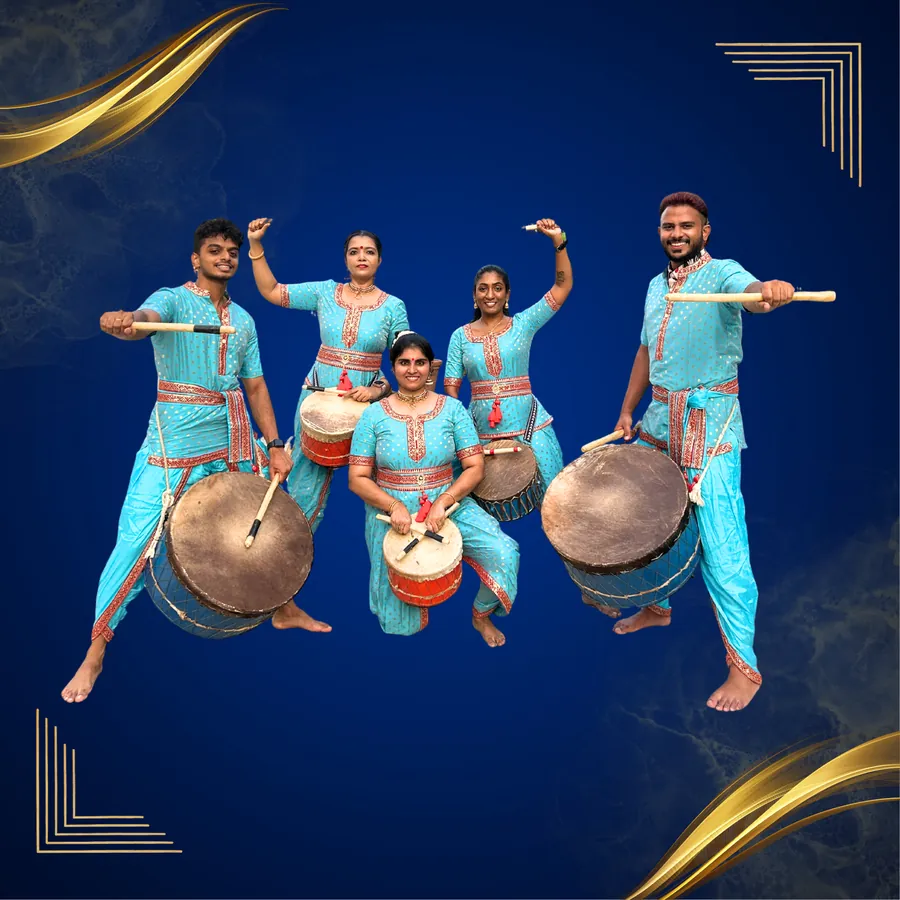
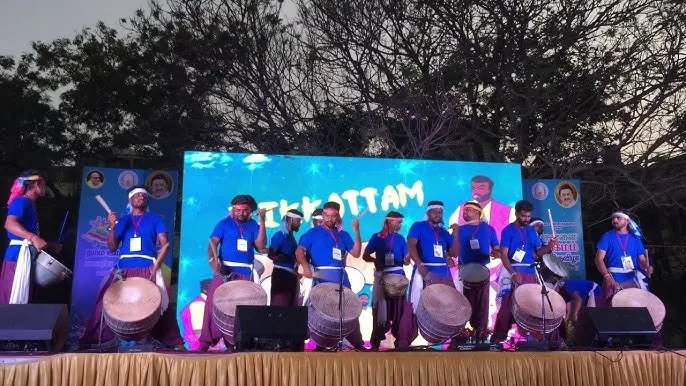
The Urumi Melam performers

Urumi Melam

Performed byVeeravel Urumi Melam

Musicians

  • Subenesh S/O Suresh
  • Thiren S/O Yeoganathan
  • V Kartish James
  • Shahkty Priyan
  • Hirendra Chettiar S/O Puspanathan Chettiar
  • Madumadhan
  • Shakthivel S/O Saravanan
  • Thilak Kumaraguru Kanthavel
  • Akshwin K M S
The Uruttu performers

Uruttu

Performed byDarshan Fine Arts

Choreographer

  • Logeshwari Durairaj

Performers

  • Lakshana Shree Kandan
  • Riyaa Rajesh
  • Neshika Yatirajula
  • Aksaramaalya Saravanan Rajamani
  • Netra Perumandla
  • Gosangi Harshitha Lakshmi
  • Rachinepalli Manvitha

Chapter 05

Art Forms of the Night

Dhunuchi Naach

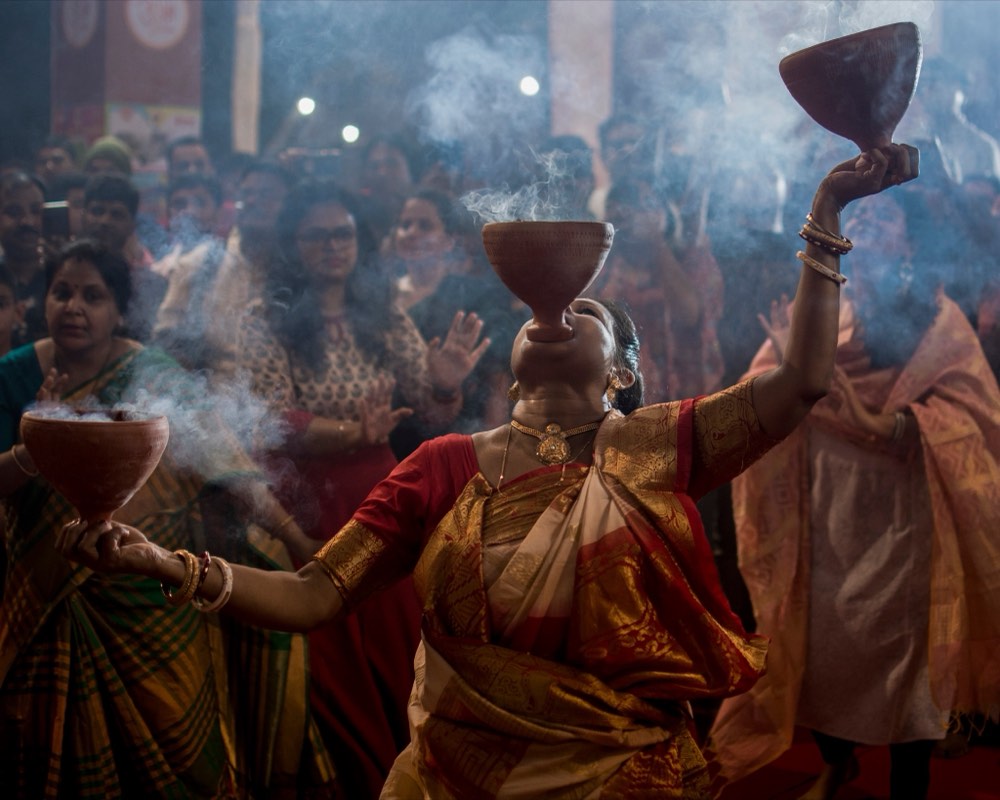
A dancer performing Dhunuchi Naach with a lit incense burner
Dhunuchi Naach · Photo Credits: Bhuppigraphy

A dhunuchi is a flared earthen or metal censer held by a stem, packed with coconut husk, lit, then sprinkled with dhuno, a resin tapped from the sal tree and often likened to frankincense. Naach, or the more formal nritya, is the Bengali word for dance. The name describes the object, not a choreography.

Several accounts state plainly that it is not known how or when Bengalis began dancing with the dhunuchi in hand. No ancient verse or manual describing the dance itself has been located.

Dhunuchi Naach, also called Dhunuchi Nritya, literally “dance of the incense burner,” is a devotional folk dance of Bengali Hindus performed with a lit censer during the autumn worship of the goddess Durga, Durga Puja.

The dance is popularly explained through the legend of Durga’s battle with the demon Mahishasura, an episode drawn from the Devi Mahatmya, a Sanskrit text within the sixth-century Markandeya Purana. Some retellings hold that her devotees kept dhunuchis burning to fortify her through the fight, which she is said to have won on the tenth day after nine nights of combat. The Devi Mahatmya itself makes no mention of a dance or an incense burner, so this connection survives only in oral and popular retelling rather than in the text — and in practice the dance is not confined to that tenth day alone.

Fieldwork among priests in North Bengal situates the ritual within Bengali Shaktism, the worship of the goddess as Shakti, or divine power, recording the belief that the dhunuchi restores the goddess’s energy much as the gods are said to have once revived her with fire and fragrance, and that the rising smoke serves a purifying function for both the ground and the devotee.

Dhunuchis are traditionally thrown in clay, with a large flared cavity and one handle, two opposing handles, or none at all. Brass and silver versions, fitted with a longer handle to blunt the heat, are also common. Potters in districts such as Nadia and Bankura produce them at scale ahead of the festival.

The tradition covers at least three distinguishable forms:

  • Dhunuchi Arati — the priest’s prescribed sequence before the idol, following a fixed pattern of passes, recorded in one village as four at the feet, two at the navel, three around the face, and seven around the whole body.
  • Dhunuchi Naach — the freer, participatory dance performed by ordinary devotees and, at larger pujas, contested in organised competitions.
  • Dhuno Pora (or Dhuno Porano) — a related household rite, generally performed by married women, in which three lit earthen plates of dhuno are balanced on wet clay pads, one on the head and one on each palm.

Both the arati and the naach are danced to the dhak, a large leather-strung drum played by hereditary drummers called dhaki, with the metal gong kasor, a bell, and ululation filling out the sound. Performers traditionally wear dhoti and kurta if male, or a garad saree — plain white silk bordered in red — if female, often with a thin cotton towel, gamcha, over the shoulder.

The dance is described in several sources as having been, for most of its history, performed chiefly by men before the idol, with women’s participation in the public, competitive form a comparatively recent development; one field study found women dancing freely within the household but largely absent from committee-run public pujas.

Skilled dancers may carry as many as three lit dhunuchis at once, one in each hand and a third gripped between the teeth. Since Indian independence in 1947, urban clubs are said to have begun holding formal competitions, typically on the evenings of Ashtami and Navami, judged on stamina, synchrony with the dhak, and inventiveness of movement. The dance recurs across several of the festival’s closing evenings rather than on the tenth day alone.

There are no official records as to when Dhunuchi Naach traditions began in Singapore.

Dhunuchi Naach remains one of the highlights of the evening programme at Singapore’s Durga Puja celebrations, performed today both at the Bengali Association Singapore’s pujo and at a separate celebration organised by the Singapore Indian Puja Association at the Singapore Sindhi Association, where it is likewise counted among the daily evening aarti’s central rites. As in Bengal, the dance continues to be carried forward as a living element of the pujo calendar, adjusted each year by the community that performs it.

  1. “Durga Puja: What is Dhunuchi Naach?,” The Statesman, 7 March 2019.
  2. “Of Dhak, Dhunuchi And Dugga Dugga,” Outlook Traveller, 31 July 2023.
  3. “When Devotion Dances: The Timeless Art of Dhunuchi Dance,” Oaklores, 1 August 2025.
  4. Ishani Saha, “Durga Puja: Some Localised Ritualistic Performances,” Lokaratna 14, no. 2 (2021): 1–17.
  5. “Mahashtami,” The Daws of Jorasanko, n.d.
  6. “Dhunuchi: The Dance with Incense, Smoke and Devotion to Goddess Durga,” 30Stades, 21 October 2023.
  7. “Durga Puja with Culture and Community Spirit,” Tabla!, 19 September 2025.
  8. “Durga Puja in Singapore,” Connected to India, 1 November 2023.

Ghoomar

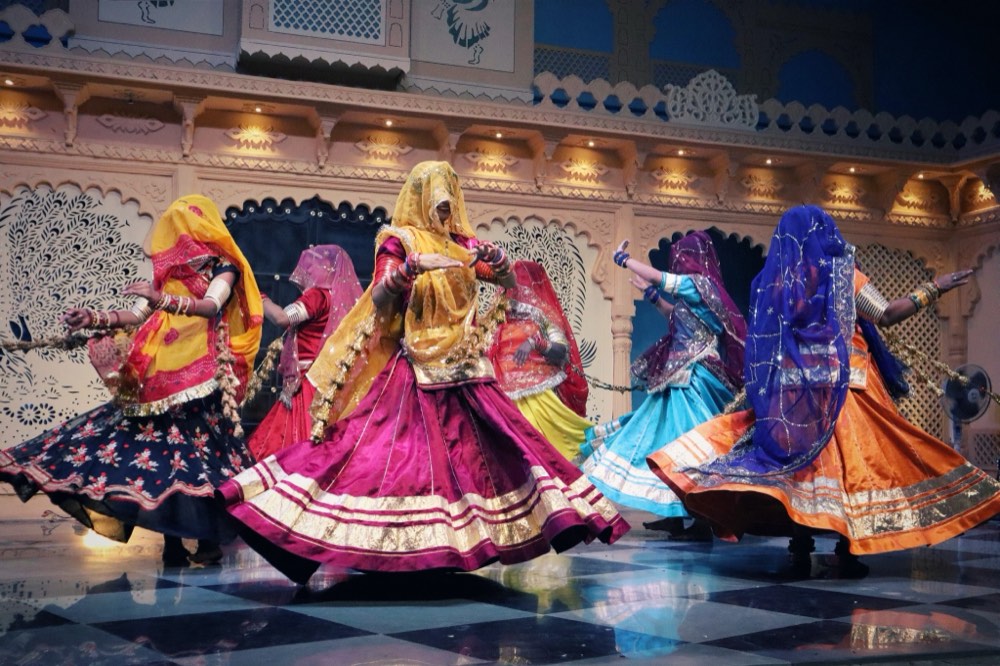
Ghoomar dancers mid-spin in pleated ghagra skirts
Ghoomar in performance · Photo Credits: Aali Jain

Ghoomar takes its name from ghoomna, to twirl. The basic step is that twirl, performed in unison by a circle of women moving clockwise and anticlockwise, clapping as they go. It is a folk dance of the Marwar region of Rajasthan, believed to have originated among the Bhil tribe before being adopted by Rajput royal households.

There is traditionally no time limit. A performance may run for hours, or through the night, as the tempo builds toward its peak.

According to a tradition recorded among Rajasthani communities, the Kachhwaha clan of Rajputs who ruled Jaipur once fought the Bhils for control of the region, and after the Bhils’ eventual defeat the two communities settled into a quiet coexistence. It is out of this reconciliation, according to the same tradition, that the Rajput aristocracy is said to have taken up Ghoomar from the Bhils, after which the dance passed into the hands of the women of the royal court and, over time, into wider Rajasthani society.

Ghoomar is closely tied to devotional and domestic ritual. It is said to have been performed originally in worship of the goddess Saraswati, and it continues to mark occasions such as Holi, the Gangaur festival dedicated to the goddess Gauri, and Teej, which welcomes the onset of the monsoon. In Rajput and allied households, a newly married bride is expected to perform Ghoomar on being welcomed into her husband’s home, joined in turn by the women of the household, both young and old, who continue dancing into the late hours of the night.

The dance is not uniform across Rajasthan. Its regional variants are distinguished chiefly by tempo and the intensity of limb movement:

  • Udaipur Ghoomar — livelier and more musical, reflecting the influence of the neighbouring Garba of Gujarat.
  • Jodhpur Ghoomar — characterised by jerkier, more intense movement of the limbs.
  • Kota-Bundi Ghoomar — set to fast, catchy melodies and regarded as the liveliest of the regional forms.

In areas of neighbouring Haryana that border Rajasthan, the dance is performed by unmarried girls to the Kehrwa rhythmic cycle at festivals including Holi, the Gangor puja and Teej, often as two facing rows of dancers who sing verses addressed to a sister-in-law.

The dancers’ attire is central to the performance. Women wear a choli, a fitted blouse, and a full or knee-length ghagra or chaniya, a voluminous pleated skirt, traditionally in cotton and, on more prosperous or ceremonial occasions, silk or chiffon. A translucent or opaque veil worked with mirror-work or gota lace covers the head, and the outfit is completed with kundan jewellery, mirror-inlaid necklaces and silver ornaments. The quantity of zari embroidery and silverwork on a dancer’s outfit has traditionally signalled the wealth of her family. Red and green are considered particularly auspicious. By some accounts, achieving the ghagra’s characteristic volume and flare can call for as much as twenty metres of fabric.

The dance itself is built around the ghoomna, the pivoting spin from which it takes its name, performed by a circle of women moving in both clockwise and anticlockwise directions while clapping their hands and occasionally joining them together. There is traditionally no fixed time limit, and a performance may continue for hours or run through the night as the tempo builds. Contemporary staged performances are commonly presented with a group of between fifteen and twenty women, accompanied by Rajasthani folk instruments including the dhol, nagada, shehnai and harmonium.

There are no official records as to when Ghoomar traditions began in Singapore.

In India, Ghoomar has in recent years moved from a domestic and courtly practice into a matter of state cultural policy. On 19 November 2025, Rajasthan’s Department of Tourism, Art and Culture, staged the first Ghoomar Festival, held simultaneously at all seven of the state’s divisional headquarters — Jaipur, Jodhpur, Bikaner, Ajmer, Udaipur, Kota and Bharatpur — with the state-level event centred on the football ground of Vidyadhar Nagar Stadium in Jaipur.

Free public workshops, including a six-day programme at Jaipur’s Jawahar Kala Kendra, were organised beforehand, and participants across all seven divisions performed to a specially composed, synchronised soundtrack. Official rules required participating groups to maintain circular formations and rhythmic synchrony throughout, on the grounds that these qualities symbolise the unity and continuity of the tradition. At the Jaipur leg, 6,100 women performed Ghoomar together in a single synchronised formation, a gathering subsequently recorded in the Asia Book of Records.

  1. Shahnaz Akhtar and Nuzhat Farooq, “Folk Dance and Music of Rajasthan: A Study of their Role in Fairs and Festivals,” Social Science Journal for Advanced Research 3, no. 4 (July 2023): 59–64.
  2. Meenu Srivastava, “Rajasthani Folk Dance-Ghoomar and Its Costume,” International Journal of Applied Home Science 6, no. 4&5 (April/May 2019): 224–226.
  3. “Ghoomar,” Art and Cultural Affairs Department, Government of Haryana, n.d.
  4. “Ghagra Choli: The Timeless Grace of Traditional Indian Attire,” AZA Fashions, n.d.
  5. “Ghoomar Dance,” Dancing Peacock, n.d.
  6. “Ghoomar Dance,” ForumIAS, 18 November 2025.
  7. “Ghoomar Festival to Be Celebrated on Nov 19: Rajasthan Dy CM,” DD News, n.d.
  8. “Ghoomar Festival 2025 – Rule Sheet,” Department of Tourism, Government of Rajasthan, 16 November 2025.
  9. “6100 Women Turned Rajasthan’s 1st Ghoomar Festival Into a Moment Now Etched in Asia Book of Records,” The Better India, 21 November 2025.

Jikkattam

ஜிக்காட்டம்

The Jikkattam performers
The Jikkattam performers · Photo Credits: Dinamani

Jikkattam is named for a sound — the sharp, repeated jik jik of the tholkaruvi, shortened colloquially from jiku jiku aattam. Local pronunciation has since softened it further, to Sikkattam. It is a fast-paced Tamil folk dance of the Kongu Nadu region, centred on Pollachi in Coimbatore district.

By 2025, artists in Pollachi and neighbouring Nanjaikundanpudur were reporting the form in decline — most earning an income from Jikkattam for only around six months of the year, through temple festivals and school and college events, and turning to daily-wage labour for the rest.

Jikkattam, increasingly rendered Sikkattam in present-day Pollachi speech, is considered by some to be a subsidiary form of the older drumming tradition of Thudumbattam. Regional press groups it among the Tamils’ traditional group dances alongside Kavadi Attam, Mayilattam and Karagattam.

The name is commonly traced to the sharp, repeated “jik jik” sound of the tholkaruvi, the dance’s principal drum. A further, unconfirmed account holds that the name may instead derive from sikkai, a musical form referenced in the Silappathikaram, though no independent textual reference naming Jikkattam by that term has been located.

The precise historical roots remain the subject of ongoing research. No textual reference to the dance has been located from the Sangam or epic periods of Tamil literature; what is documented instead comes from twentieth- and twenty-first-century ethnographic and press accounts.

By 2025, artists were calling on the Tamil Nadu government for formal recognition and support to sustain the tradition.

A Jikkattam troupe requires a minimum of fifteen performers to stage a full performance. It is led by a kuzhu thalaivar, or group leader, known in some accounts as the annavi, who directs the tempo and cues transitions with a whistle. Performers number at least ten to fifteen, are drawn almost exclusively from men, and are arranged in lines.

The ensemble’s core instrument is the thudumbu, known locally in Pollachi as the Pollachi Kumba, typically played alongside an uruttu, a barrel-shaped drum used in roughly equal proportion, and in some present-day troupes maracas. Wider accounts additionally list the kanjiru, nagari, jalra, tappu, kol (a stick), and the whistle used by the troupe leader. Performers wear brightly coloured costume with ankle bells and play their instruments positioned between the legs while dancing.

Jikkattam is danced at a fast tempo from beginning to end while remaining, by most accounts, graceful. Performances are not bound to a fixed length and can run for more than two hours. The form comprises several distinct routines, described in one 2025 news report as four in number:

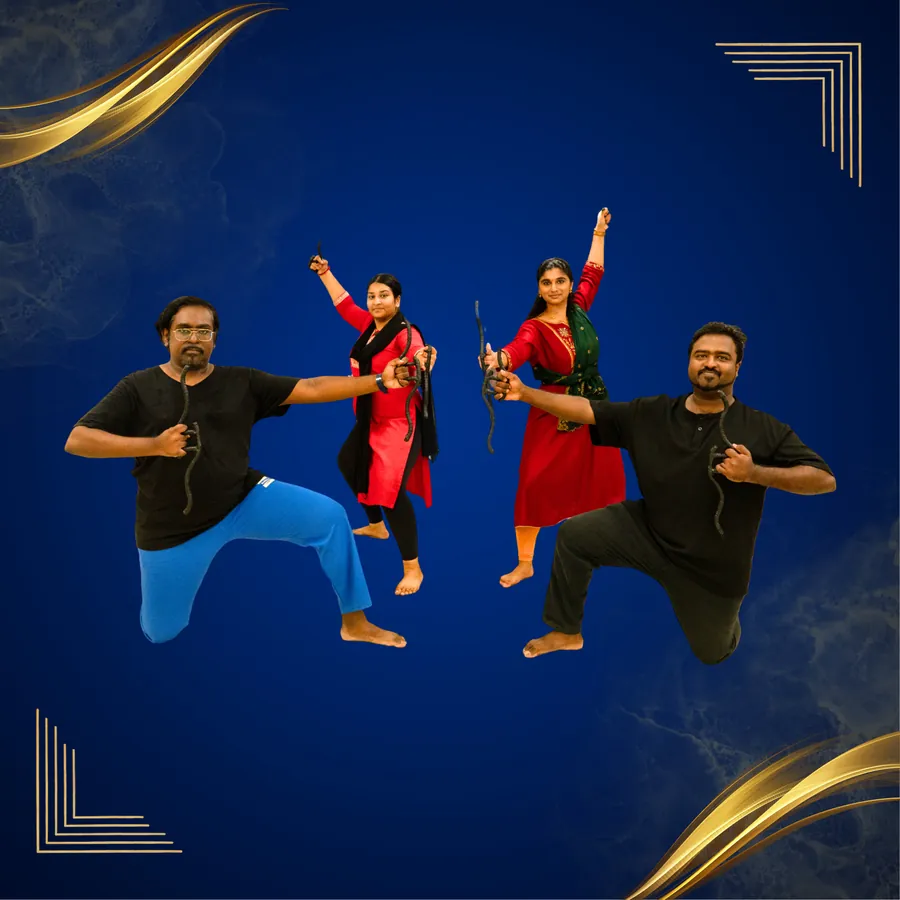
  • Jigur Attam — performers hold a pagalai and a handkerchief, and wear a khol, or varisai.
  • Oyilattam — a related dance of grace performed in rows to handkerchiefs and ankle bells, native to southern Tamil Nadu and especially prevalent in Kongu Nadu.
  • Themmangu — a further routine sharing steps in common with Jikkattam’s broader repertoire.

Several colleges in the Coimbatore region now offer instruction in Jikkattam.

There are no official records as to when Jikkattam traditions began in Singapore.

In Singapore, many present-day stagings of Jikkattam now pair the traditional instruments with recorded drum tracks, even as dancers continue to move in sync with the troupe leader’s whistle cues.

Back in the Pollachi region from which the art form originates, its practitioners describe an uncertain future, sustaining the tradition on a part-time basis alongside daily-wage work, and appealing publicly for government recognition to help it survive into the next generation.

  1. Interview with Kalai Valarmani Sakthi Ravanan, 2026.
  2. Dinakaran, “தமிழர்களின் பாராம்பரிய ஆட்டக் கலைகளில் ஒன்றான ஜிக்காட்டம்,” 15 July 2025.
  3. Tamil Janam, “ஜிக்கு… ஜிக்கு… சிக்காட்டம்,” 10 July 2025.
  4. Silverscreen India, profile of a Coimbatore-based Jikkattam performer, 18 December 2021.

Kalaripayattu

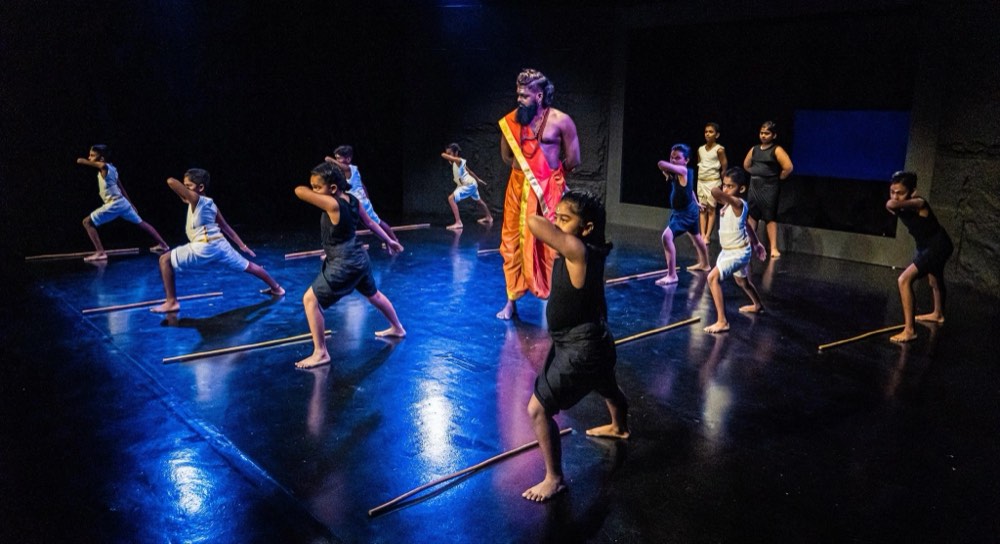
Kalaripayattu practitioners training with weapons
Photo Credits: Kalari Academy Singapore

Kalari is a compound of two Malayalam words — kalari, the training ground, and payattu, training in the arts of combat. Together, roughly: practice in the arts of the battlefield. It is widely regarded as among the oldest surviving fighting systems in the world.

It is fought in a pit dug to the principles of Vastu Shastra, forty-two feet by twenty-one, six feet deep, entrance facing east, its floor of compacted earth or red sand. In its southwest corner stands the Poothara, a seven-tiered platform housing the guardian deity, before which students salute at the start and close of every session.

Kalaripayattu is native to Kerala and combines armed and unarmed combat, ritual and traditional healing.

By legend, the sage-warrior Parashurama, revered as the founder of Kerala, established the first of 108 kalaris across the land and trained twenty-one gurus in the destruction of enemies. The word kalari also surfaces independently in Tamil Sangam literature of roughly the third century BCE to the second century CE — in the Purananuru (verses 225, 237, 245 and 356) and the Akananuru (verses 34, 231 and 293) — but there it describes a battlefield or combat arena rather than a distinct art.

Some historians connect the crystallisation of Kalaripayattu as a discipline to the prolonged eleventh-century wars between the Chera and Chola kingdoms.

The tradition suffered a severe setback in 1804, when the British banned its practice in Kerala after the Cotiote War, a rebellion led by the Keralite ruler Pazhassi Raja. Several Gurukkals, or masters, are credited with preserving the art in secret through the ban, and a public revival began in Thalassery in the 1920s.

Instruction traditionally proceeds through four stages:

  • Meythari (or Meipayattu) — exaggerated body-conditioning exercises intended to make “the body an eye.”
  • Kolthari — wooden weapons, such as the kettukari, a long staff roughly the height of the practitioner, and the curved otta.
  • Ankathari — metal weapons: the valum parichayum (sword and shield), the kuntham (a spear tipped with a metal head around one to one and a half feet long), and the urumi, a flexible double-edged sword worn coiled at the waist like a belt and considered one of the most dangerous weapons in the system.
  • Verumkai — unarmed combat.

Practitioners train in a loincloth called the kachakettal, red-and-white or red-and-black, five to six feet long and about a foot wide, wound tightly around the hips. Sessions are preceded by uzhichil, a therapeutic oil massage administered by the gurukkal, sometimes in a trough called the dhaarathoni, using medicated oil believed to counter the heat generated by training and to aid recovery from injury.

Because a well-placed strike to the marma, the vital points of the body, can maim or kill, knowledge of those points — drawn from Ayurvedic and Siddha medicine — is taught alongside the corresponding treatments, marma chikitsa.

The art divides into named regional styles:

  • Vadakkan Kalari — the Northern style, practised chiefly in Malabar, emphasising flexibility, evasive footwork and jumps.
  • Thekkan Kalari — the Southern style, near Kanyakumari, favouring hard, impact-based techniques and pressure-point strikes.
  • Madhya Kalari — the Central style, a composite of the two with its own distinctive footwork.
  • Tulunadan Kalari — a smaller style referenced in the ballad tradition, largely confined to Tulu Nadu.

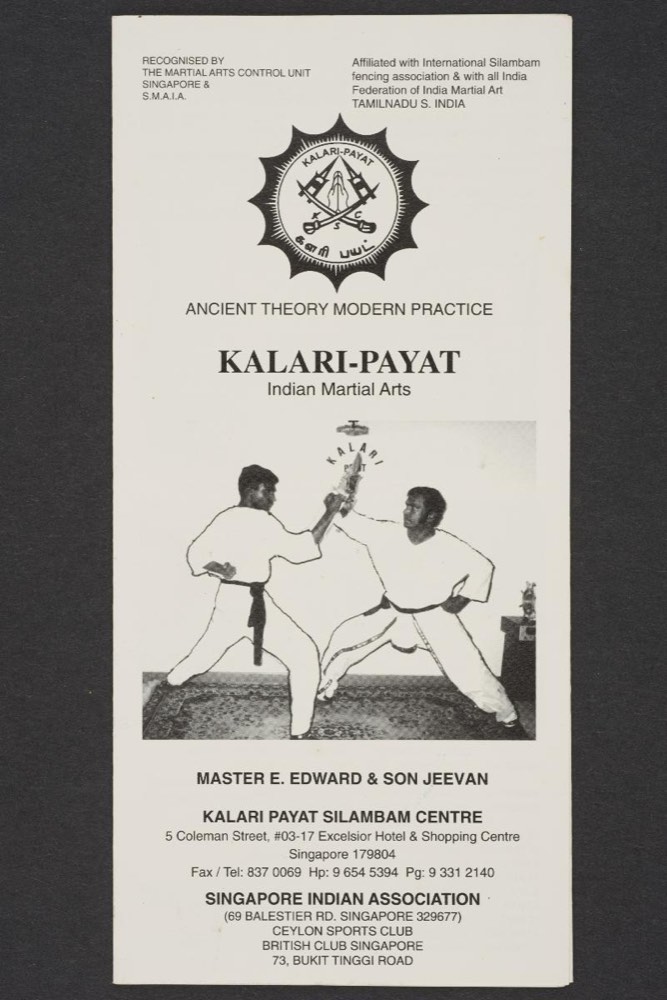
The martial art travelled beyond Kerala through Master Marama Assan Ebenezer Dharmaraj Nadar, who established a Kalari-Payat training club in Ipoh, Malaysia, in 1938, introducing the tradition to Malaya.

Archival brochure for Kalari Payat
Brochure of Kalari Payat · Photo Credits: Roots, NHB

His son, Master Elenasiar (Eddie) Edward, went on to found the Kalari-Payat Silambam Centre in Singapore during the 1970s, formally registered under the Singapore Martial Arts Association in 1988, drawing Indian practitioners across the island to train in the traditional weaponry of both Kalaripayattu and Silambam.

Vedagiri Govindasamy, first enrolled by his father into Eddie Edward’s school in the early 1980s, went on to found Kalari Academy in Singapore in 2015 together with Reuben, establishing what has since become the island’s dedicated home for the two forms.

Kalaripayattu has transcended its historical function as a feudal battlefield system, evolving into a discipline encompassing performative art and holistic fitness. Training has been adapted to modern urban life: the Kalari Academy of Singapore offers specialised cohorts, including ladies-only fitness classes that blend traditional martial arts with modern wellness goals.

Its performative dimensions have flourished through cross-cultural theatre. The Academy’s creative wing, K A Kreative, has pioneered original martial-arts stage plays. In February 2024 they staged Saptamaatrika at the Asian Civilisations Museum as part of the Light to Night Festival, fusing choreographed Silambam sequences with the mythological battle of the seven Mother Goddesses. In September 2024 they debuted Immortal at the Stamford Arts Centre, exploring the life of Parashurama and his mastery of Kalaripayattu.

Efforts have also been made to bring Singapore’s wider multicultural community into shared training, and increasingly into collaboration with the island’s Chinese and Malay martial art traditions.

  1. “Kalaripayattu or Kalarippayattu – the Martial Art form of Kerala,” Kerala Tourism, n.d.
  2. Thanooja Devi, “The Kalari, Gymnasium of Kerala,” JETIR, November 2020.
  3. “Kalari — the Training Area for martial art,” Kerala Tourism, n.d.
  4. “Kalaripayattu Weapons,” Kadathanadan Kalari, 8 January 2023.
  5. “Kacha Kettal — Wearing Traditional Dress,” Kerala Tourism, n.d.
  6. “Preparations for Kalari Training — Uzhichil or Massage,” Kerala Tourism, n.d.
  7. “Kalari Treatment | Kalari Chikitsa / Kalari Uzhichil,” Kerala Tourism, n.d.
  8. “Surul,” Roots.gov.sg, n.d.
  9. “Photograph of Elenasiar Edward Training With Komathi,” Roots.gov.sg, n.d.
  10. “Silambam,” Roots.gov.sg, n.d.
  11. “Kalari Academy of Singapore,” National Library Board.
  12. “Saptamaatrika | A Martial Arts Stage Play,” Kalari Academy, n.d.
  13. “IMMORTAL,” Kalari Academy, n.d.
  14. Dinesh Vasu Dash, “Speech at Kalari Academy’s Tenth Anniversary Event,” Ministry of Culture, Community and Youth, 19 July 2025.

Kambathattam

கம்பத்தாட்டம்

The Kambathattam performers
The Kambathattam performers · Photo Credits: ATAM

Kambathattam is literally pole-dance — kambam, a wooden post, and aattam, dance. A ceremonial pole is honoured and danced around as an offering, tied to village deity worship in rural Tamil Nadu.

Every round opens with a virutham, an unmetered devotional verse sung in praise of the presiding deity, carrying social commentary and honouring the performers’ village and lineage. The adi, the pattern of strikes performed around the pole, changes from round to round rather than repeating a fixed sequence.

Kambathattam is a compound of kambam (கம்பம்), a wooden pole or post, and aattam (ஆட்டம்), dance. It is a Tamil ritual performance tradition built around a ceremonial pole that is honoured and danced around as an offering, tied to village deity worship in rural Tamil Nadu.

The word kambam is understood in everyday Tamil usage to denote a post or pillar — a meaning also carried in the rural custom, recorded in some accounts of Tamil agrarian life, of farmers raising a plain wooden post in the field and worshipping it before the start of the planting season.

The specific written history of Kambathattam as a performance form remains scarce. Its practice today is sustained chiefly through the oral and practical knowledge of its practitioners rather than through textual record.

The kambam at the centre of the dance is fashioned to one of two customary lengths, fifteen saatru or seven saatrusaatru being a traditional linear measure used by its makers — with the choice reportedly depending on the specific round or occasion of performance.

Accompaniment is traditionally provided by the moda melam, an ensemble named for the moda (மொடா), or pot, at its core, together with the aligi satti, the kombu, and the kai thaalam (hand cymbals). The moda melam is built around clay pots, or paanai, whose two faces are stretched with thol (leather) and tied to the waist of the player:

  • Thondi mathalam — a clay pot drum forming one half of the moda melam pairing.
  • Paanai mathalam — the companion clay pot drum, played alongside the thondi mathalam.
  • Aligi / Ara chatti — a smaller pot, a lighter-toned counterpart to the main moda drums.
  • Thamukku — a kettle drum braced and tuned with leather straps, elsewhere documented as a fixture of the naiyandi melam ensembles that accompany Tamil folk dance more broadly.
  • Kombu — a curved horn, historically fashioned from buffalo horn and today more often cast in bronze, brass or copper, blown while standing with the instrument held in line with the body.

Kambathattam was traditionally performed by men, though women have increasingly taken up the art in recent years. The adi, the pattern of strikes performed around the kambam, changes from round to round rather than repeating a single fixed sequence. Each performance opens with a virutham, an unmetered devotional verse form used elsewhere in Tamil temple and concert traditions to precede a song, sung here in praise of the presiding deity. A fresh virutham is sung again at the start of every subsequent round, marking the transition between rounds rather than being confined to the opening.

There are no official records establishing when Kambathattam traditions began among the Tamil community in Singapore.

One resonance is worth noting, though its bearing on the dance itself remains speculative. Early Singapore Tamils used kambam not only for a pole but also for a settlement: the area around today’s Little India was known as Soonambu Kambam, the “village of lime,” after the lime kilns once worked there by Tamil labourers, and the area’s Sri Veeramakaliamman Temple was accordingly called Soonambu Kambam Kovil, the “temple at the lime village.” The same usage appears in the Tamil naming of other early settlements in colonial Singapore, such as Chulia Kambam for the Chulia enclave along what is now Chulia Street, with kambam there glossed directly as the Malay kampong.

The same usage appears in the Tamil naming of other early settlements in colonial Singapore, such as Chulia Kambam for the Chulia enclave along what is now Chulia Street, with kambam there glossed directly as the Malay kampong. Whether it shares any real root with the kambam of Kambathattam, the pole, is not established.

Kambam selection for a performance is entrusted to a pathiyakarar (பாத்தியக்காரர்), a custodian appointed to each temple, whose specific role and manner of selection varies according to the oor (ஊர்), or home village, associated with that temple.

As with related Tamil folk traditions, the participation of women in a practice once dominated by men continues to grow, and it is through this same round-by-round structure of virutham and adi that younger practitioners continue to learn the dance today.

Youth performing the art form today are commonly seen in denim trousers, white button-down shirts, a head scarf and ankle bells, or salangai.

Apart from festive seasons, villagers are noted to have frequently danced Kambathattam after work in the fields or as labourers, as a mode of relaxation.

  1. Interview with Kalai Valarmani Sakthi Ravanan, 2026.
  2. “5 Instruments From South India: An In-Depth Look,” Splice, n.d.
  3. “Little India Heritage Trail,” National Heritage Board / Roots.gov.sg.
  4. Indian Heritage Centre, “Sign of Times” exhibition text, n.d.
  5. “Thaalathukerpa Nadanam Kalaikattum Kambathattam,” Dinamalar, 2023.

Maankombu

மான் கொம்பு

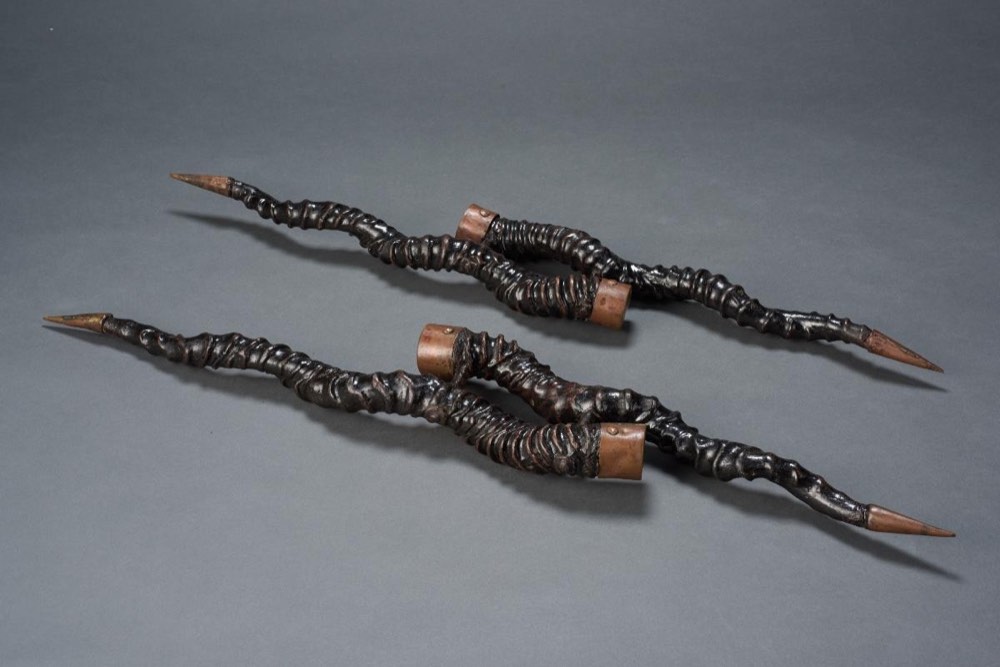
A maduvu of paired blackbuck horns joined by crossbars
Maduvu, Indian Heritage Centre collection · Photo Credits: Roots, NHB

Maankombu means deer horn. It is a weapon and its discipline, practised within Silambam, the staff-fencing art of Tamil Nadu, and it is treated in practice as a double-bladed dagger — a pair of curved blackbuck horns pointing in opposite directions, joined at the centre by crossbars that double as a handle.

It is thought to descend from a simpler implement carried by wandering ascetics, the jogis, who were forbidden by their order from bearing conventional weapons and adapted a single antelope horn into a crutch that doubled as a means of self-defence. Because the horn’s density made it hard to cut through with a sword, it served as a small shield as much as a blade.

Silambam, the wider stick-fighting system within which the maankombu is trained, is well attested in Sangam-era Tamil sources. Scholars point to the Tolkappiyam and other early works as evidence that structured staff-fighting instruction, and dedicated training grounds resembling gymnasiums, existed in Tamil Nadu before 300 BCE. By a legend recorded by Singapore’s heritage authorities, the sage Agastya encountered Lord Murugan and learned meditative practices from him, afterward conceiving the texts and disciplines said to underlie Silambam.

The maankombu itself is far more sparsely documented than the bamboo staff at the centre of the art. Its history before the colonial period rests largely on oral transmission among practitioner lineages.

The weapon takes its name from the pair of curved horns, traditionally sourced from the Indian blackbuck (Antilope cervicapra), from which it was originally fashioned.

The maduvu typically consists of two blackbuck horns joined at the centre by a pair of crossbars, with later variants tipped in steel or fitted with a small guard plate. A nineteenth-century example, formerly part of the Haggerty Museum of Art, measures 61 centimetres by 16 and combines juvenile blackbuck horns with brass caps and a discoid brass shield. Modern training replicas are commonly listed at roughly one kilogram apiece.

In combat the maduvu is chiefly defensive. The wielder favours a low stance, staying beneath the opponent’s centre of gravity to close off openings to the body’s vital points, before parrying an incoming strike and countering with a thrust, choke, lock or disarm. Training draws on animal-inspired stances — frog, snake, mouse, tiger, elephant and eagle — echoing the animal vocabulary found elsewhere in Silambam’s unarmed footwork. A bout traditionally opens with a mutual salutation.

Among the weapon’s principal variants:

  • Maduvu / Madu — the standard Tamil Nadu form, a pair of blackbuck horns joined by crossbars, often tipped with steel points.
  • Maru — a later regional variant associated with Punjab, forged entirely from steel rather than horn.
  • Jogi crutch-staff — a related single-horn implement carried as a walking aid and concealed defence by ascetics barred from conventional weaponry.

Advancement to maankombu training is not offered to beginners. Instructors reserve the weapon — described in some schools as an advanced pattern called Maan Kombu Sala-Varisai — for practitioners who have already progressed through footwork and unarmed forms, with instruction sometimes preceded by a graduation ritual, arangetram, conducted within a temple.

Maankombu is sparsely documented in Singapore’s historical record, never having been described separately from the wider Silambam tradition it forms part of. It is understood to have arrived, as Silambam generally did, through early contact between South Indian and Southeast Asian communities.

The weapon continues to be taught in Singapore only within established Silambam academies, such as the Kalari Academy, as an advanced component of their weapons curriculum. Practised now largely as a self-defence and fitness discipline rather than a battlefield skill, the maankombu remains one part of a living, still-evolving Silambam curriculum rather than an independently preserved art form.

  1. David Manuel Raj, “The Origin & Historical Development of Silambam Fencing” (XXIV Seoul Olympic Scientific Congress, Danhook University, Seoul, 1988).
  2. “Silambam,” Roots.gov.sg, n.d.
  3. “Mid-19th C. Indian Blackbuck Horn & Steel Maduvu,” Invaluable / Artemis Fine Arts, auction listing.
  4. “Black Silambam Maan Iron Kombu Maduvu Iron,” IndiaMART, n.d.
  5. Tamil Nadu Tourism Info, “Exploring the Art and Heritage of Silambam: Indian Stick Fighting,” 17 March 2025.
  6. “The maduvu, also known as a maru or madu,” Tamil Heritage, n.d.
  7. “The Kalari Academy Singapore,” n.d.

Mayilattam

மயிலாட்டம்

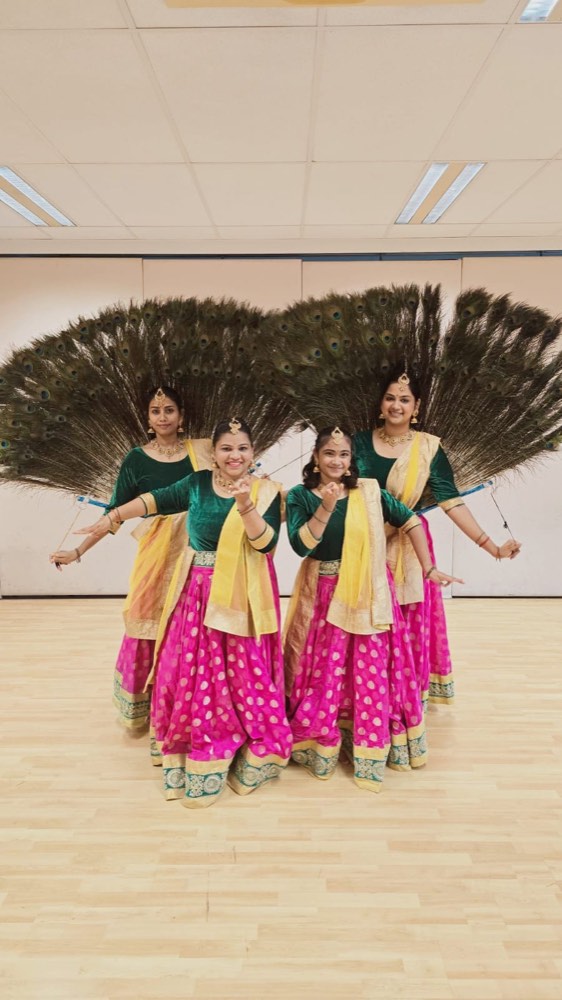
A Mayilattam performer in peacock costume
A typical Mayilattam performer · Photo Credits: ATAM

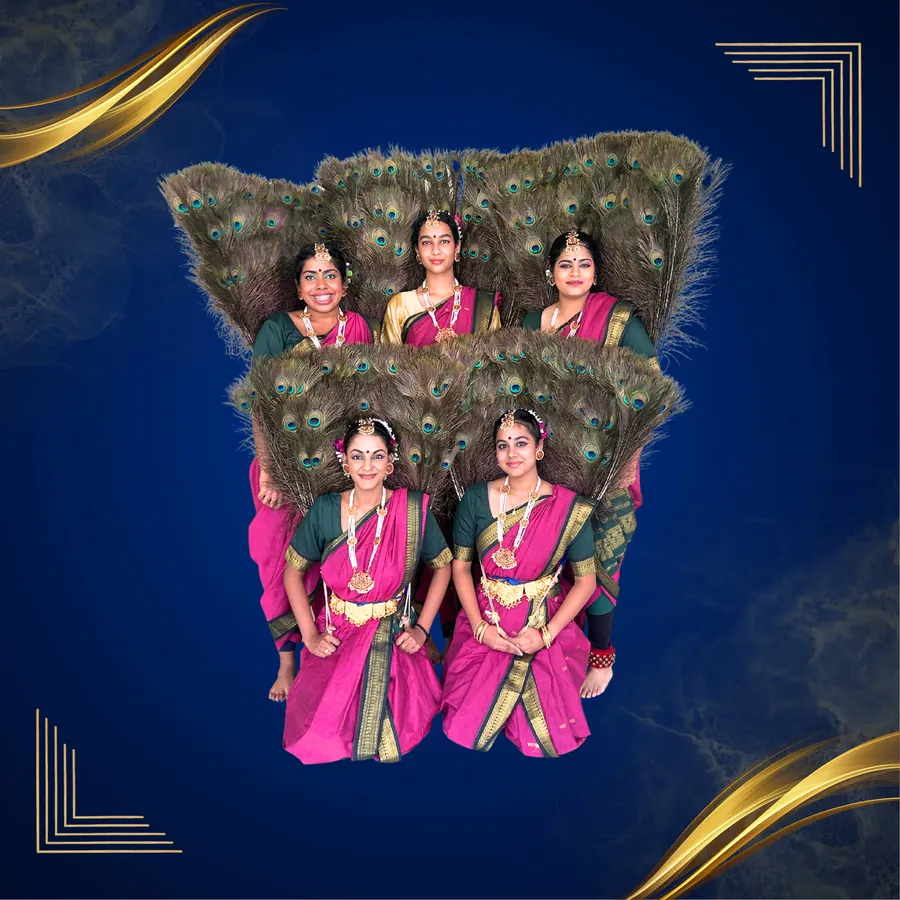
Mayilattam is the peacock dance, performed in the temples of Tamil Nadu and Kerala in honour of Murugan, whose vahana — divine mount — is the peacock. Devotees dance it both as penance and as thanksgiving.

The performer imitates the bird: leaping, opening its feathers in joy, some even opening the beak to pick up objects, bending to the knees or lying on chest or back to emphasise the feathers spreading behind. It is known as Mayura Nritham in Kerala and Mayur Nritya in Uttar Pradesh, where it is danced instead in worship of Krishna.

The origins of Mayilattam are intertwined with the mythology of Lord Murugan, whose mount is the peacock, symbolising majesty, purity and spiritual victory. The stylised imitation of the peacock’s movements — graceful, bold, vibrant — mirrors Murugan’s qualities and the animal’s significance in Tamil iconography. Devotees perform it believing it pleases the deity and invites divine blessings.

The art form has been depicted in the Ramayana and in Sangam literature.

Dancers wear elaborate costumes with peacock feathers and headdresses, often mounted on tall wooden stilts. The replica of the peacock adds to the dramatic and religious significance of the performance. Its body and head are typically hand-made from papier mâché and clay, painted in hues of green and blue, while the feathers are formed from paper. The structure covers the performer from the ankles to around the chest, with the feathers fitted behind the shoulders.

Performers may hold a vel, the weapon carried by Lord Murugan, and wear an elaborately decorated headgear with a flower garland. They are usually male, their faces made up with sandal paste and dramatic features resembling Murugan. Naiyandi Melam forms the musical accompaniment, as it does for Poikkaal Kuthirai Aattam and Karagattam.

There are no official records as to when Mayilattam traditions began in Singapore. The earliest record appears to be 1950, when Mayilattam was staged at the Singapore Indian Fine Arts Society’s concert. Today, workshops coordinated and conducted by multiple arts groups are commonplace.

The full peacock structure is rarely used in Singapore. Instead the detachable, movable feathers have become the essential component, and the shaking of those feathers from side to side by hand is the current defining feature of the art form, performed primarily by women. More recently, Bharatanatyam dancers have been seen using the feathers in Mayilattam-inspired segments of their repertoires.

Oyilattam

ஒயிலாட்டம்

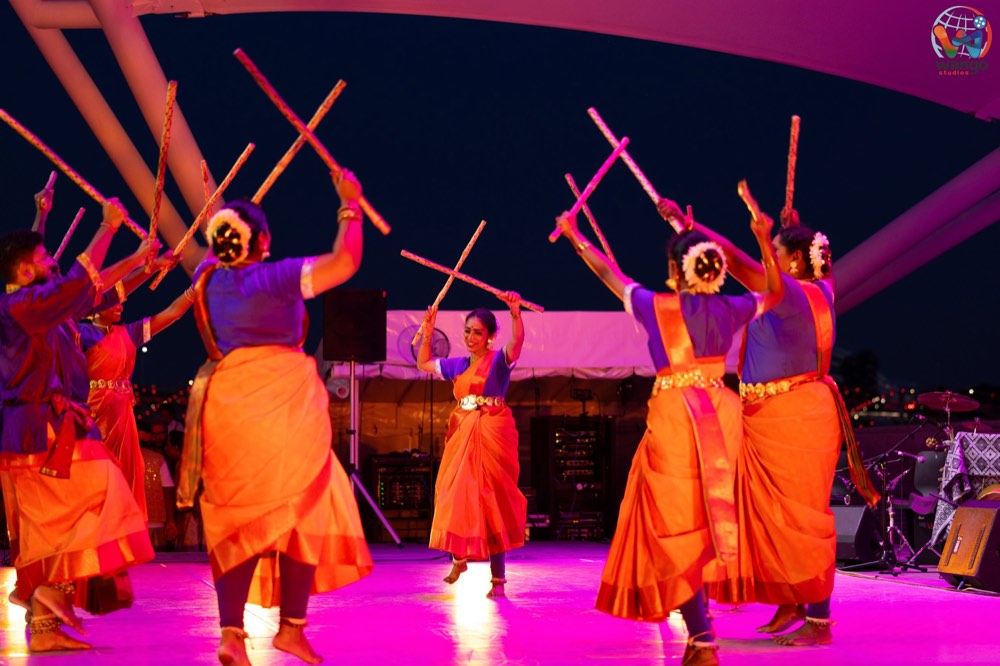
Oyilattam dancers in a row, a coloured scarf held in each hand
A typical Oyilattam performance · Photo Credits: ATAM

Oyil means grace. In Madurai, where the dance began, that word is a standard the performer has to meet. A coloured scarf in each hand, salangai bells at the ankles, and sixty-four movements to carry through.

The rules are exact. Dancers stand one muzham apart, roughly a cubit, and never touch. Legs stay clear of one another. The scarf must not fall. Behind the line the thavil and jalra keep time while the guru dances at the front and leads the singing, and the rest follow him into verses from the Ramayana and the Mahabharata that were handed down by voice alone.

Oyilattam originates in Madurai, Tamil Nadu, and is danced at village festivals, including the Mulaippaari rituals held in prayer for rain.

It is also known as Oyil Kummi, which suggests it may once have been the male counterpart to Kummiattam, a form performed mainly by women.

In early practice men danced in one or two rows, a coloured scarf in each hand and salangai tied at the ankles, accompanied by thavil and jalra. The scarf, shaken through a range of movements, is the form's most recognisable feature. Dancers wear a mundasu headscarf and a flower garland. In temple performances the men dance bare-chested, marked with santhanam and viboothi, with minimal makeup.

There are no age limits, and a group of ten to twelve is preferred. The guru dances ahead and the others follow his movement and his singing. Oyilattam and silambam share movement patterns closely enough that practitioners say learning silambam first makes the dance easier to pick up, since both demand disciplined control of the body.

No official record marks when Oyilattam took root in Singapore. Workshops run by arts groups are common, and the form appears regularly at community festivals. A mass Oyilattam event in 2023 entered the Singapore Book of Records. It was showcased at Anandha Kondaattam 2024, the Indian Heritage Arts Fiesta 2024, and Anandha Kondaattam 2025, all organised by ATAM.

Women are increasingly seen performing Oyilattam, and varied formations now stand in for the single row. Alongside devotional and historical songs, pieces carrying social messages have become common, and the karagam appears in some performances.

In the United States, the New Jersey Tamil Peravai recently set a Guinness World Record for the largest Tamil folk art performance, teaching Oyilattam to 459 participants.

  1. A. Shanmugam Pillai, “ஒயிலாட்டம்,” n.d. tamilvu.org
  2. D. Ramachandran, “Social Worship Tradition and Oyilattam in Field Study,” International Research Journal of Tamil 4 (1 December 2022). DOI: 10.34256/irjt224s-22260

Poikkaal Kuthirai Aattam

பொய்க்கால் குதிரை ஆட்டம்

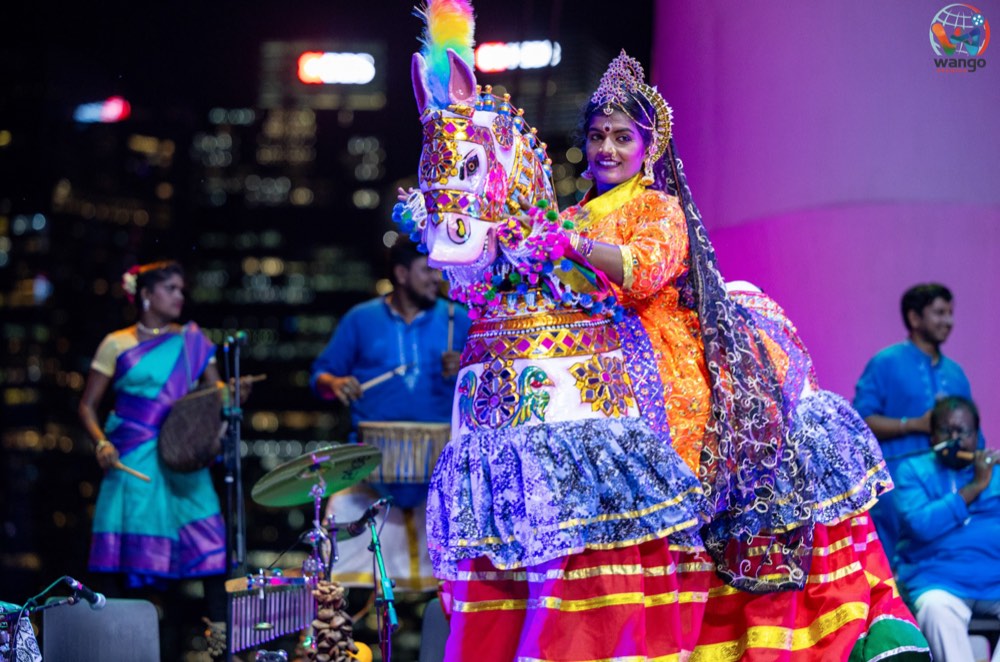
A Poikkaal Kuthirai Aattam performer wearing the horse frame
Poi Kuthirai Aattam · Photo Credits: ATAM

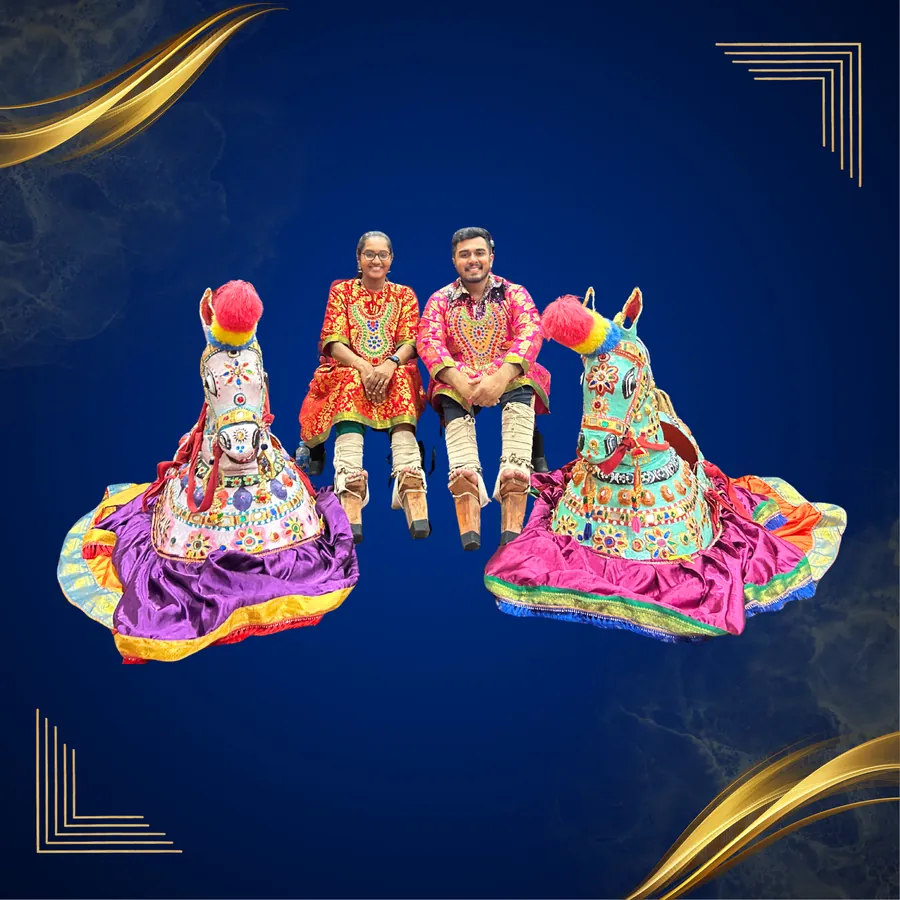
Poikkaal Kuthirai Aattam, also called Puravi Attam, translates as “dummy horse dance.” A hollow horse-shaped frame is slung from the shoulders and sits at the waist, its side panels swaying to hide the performer’s legs. It weighs twenty-five to thirty kilograms.

The tradition is thought to root in the wooden-legged dance Marakkaal Aattam, referenced in the Silappathikaram and believed in mythology to have been performed by the goddess Durgai Amman to destroy demons who had taken the forms of snakes and scorpions.

காய்சின வவுணர் கடுந்தொழில் பொறாஅள்
மாயவ ளாடிய மரக்கா லாடலும்

Not enduring the angry demons’ deceit,
the wrathful dance performed by Maayaval.

Silappathikaram · கடலாடு காதை, 58–59

The dance is thought to have its roots in Marakkaal Aattam, the wooden-legged dance referenced in the Silappathikaram, estimated to the fifth century BCE.

The custom of madal eruthal — whereby a man whose wish to marry a woman is opposed by her parents fashions a horse figure from palm leaf, carries it on his body, and parades through the streets in protest and desperation to proclaim his desire — seems to have been prevalent in the Sangam era. It appears in the Tholkappiyam:

ஏறிய மடல்திறம் இளமை தீர்திறம்
தேறுதல் ஒழிந்த காமத்து மிகுதிறம்

The practice of madal eruthal;
love that blossoms beyond age divides;
the declaration of desire during long separation;
extreme acts driven by overwhelming lust.

Tholkappiyam · பொருளதிகாரம், 56

The horse figure was made from leaves and embellished with silk-cotton, milkweed and avaram senna flowers. There is no historical evidence that this ever took the form of a dance using false legs to imitate riding a horse.

The addition of the defining horse replica is believed to have occurred during the Maratha rule of Thanjavur, seventeenth to nineteenth century CE. The Marathi equivalent still practised today is Ghode Modni in Goa, which emerged as a processional dance celebrating the victorious return of rulers and warriors. It is also seen in Rajasthan as Kachchi Ghodi, and in Andhra Pradesh as Keelu Guralu.

A hollow horse-shaped frame, crafted from light materials such as jute, paper, cardboard and glass, forms the core of the costume, with side panels that sway and hide the performer’s legs. The replica weighs around twenty-five to thirty kilograms and is usually hung from the shoulders, fitting around the waist. Decoration differs by region: in Tamil Nadu the horse’s neck and head are white, its body draped in two or three layers of colourful bordered cloth; in Rajasthan the replica features hues of red, mirrorwork and cloth tassels.

To mimic the sound of galloping, dancers attach wooden stilts or blocks of around 1.25 to 1.5 feet to their legs, producing hoof-like sounds with each step. The blocks are usually made of banyan tree roots. Practitioners note that mastering the form requires at least forty-eight days of training on wooden stilts to develop proper balance.

During the performance the dancer may wield a sword or whip. A pair of male and female dancers usually perform together as King and Queen, their attire reflecting those characters — elaborate, glittery jippa or kurta with a crown or colourful turban for men, and lehenga-like skirted costumes with a tiara-like headgear, sometimes connected to a veil, for women.

Naiyandi Melam usually forms the accompaniment. A double-faced percussion instrument called the kunthalam is essential: two cowhide faces side by side, each struck by a bamboo stick. It is referenced in the Silappathikaram as one of the thirty-three instruments used in Madhavi’s dance recital, and is believed to be the modern version of the kinai parai, referenced in the Tholkappiyam.

There are no official records as to when Poikkaal Kuthirai Aattam traditions began in Singapore. Community festivals today feature Poi Kuthirai Aattam, and the use of wooden stilts is rarely seen.

Separately, it must be noted that Kuda Kepang or Kuda Lumping, a visually and performatively similar art form originating in Java, Indonesia, is often practised in many Southeast Asian countries including Singapore, and is believed to have been introduced here in 1948. That dance also involves mounting a dummy horse made of paper and cardboard, although the making of the structure, the performative elements and the costumes all differ from Poikkaal Kuthirai Aattam.

Attaching the wooden stilts is increasingly rare, with many performers merely using the hollow horse structure and dancing on their own legs, to which anklet bells are attached. This is referred to as Poi Kuthirai Aattam. In the past, male dancers enacted both the King and Queen parts; the participation of women has increased since.

Sakkai Kuchi Aattam

சக்கை குச்சி ஆட்டம்

Sakkai Kuchi Aattam performers striking sticks in pairs
Sakkai Kuchi Aattam · Photo Credits: ATAM

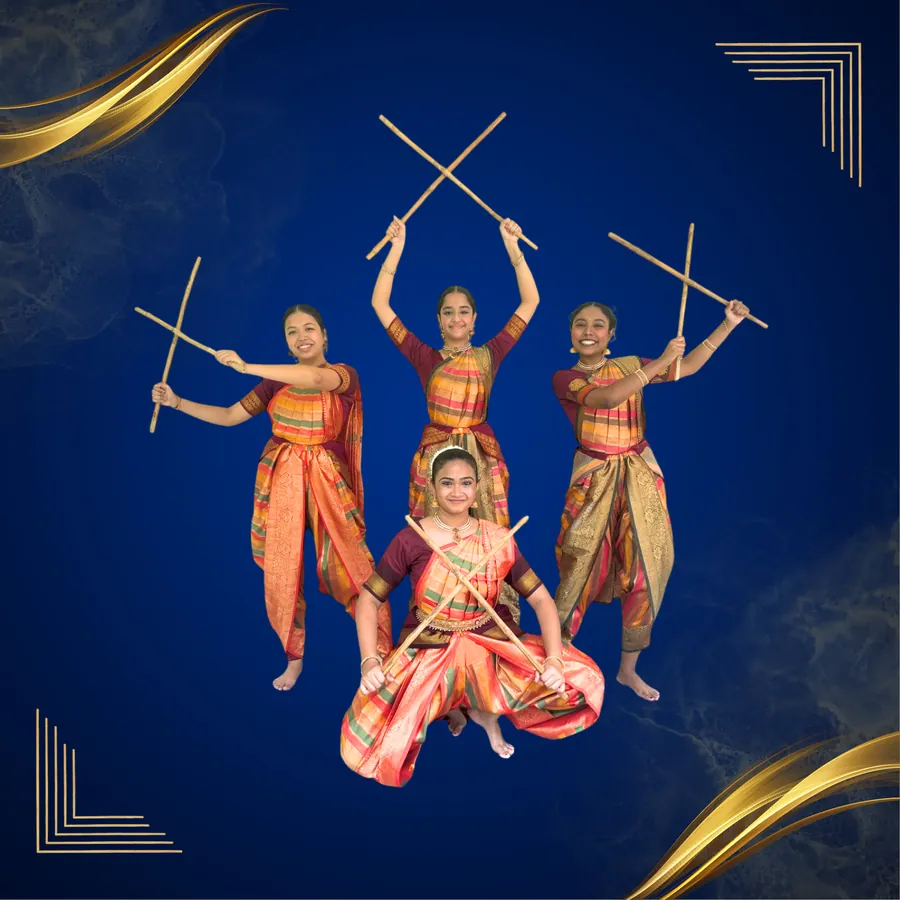
The sakkai is four short teakwood sticks tied together with string, held in one hand with each stick between two fingers. The hand movement mimics the rapid scooping of water, and the sticks snap sharply against one another. In the other hand, or in both, the dancer holds the chedi kuchi, a long stick about two and a half feet.

Dancers work strictly in pairs, striking each other’s sticks in coordinated patterns, in parallel or circular formations, never fewer than six. Some of the footwork resembles silambattam. There are no lyrics; the thavil and pambai carry it.

Originating in Tamil Nadu, Sakkai Kuchi Aattam is believed to have been born out of war training. There is no apparent record of when it was first practised. It is believed to have become a sport in the colonial era and thereafter a dance form, possibly initiated by low-wage coolie workers from plantain godowns as a pastime.

Presently there are only about fifty trained Sakkai Kuchi Aattam artistes left in India.

The form combines the sakkai and the kuchi as props. Four short teakwood sticks, usually 16 centimetres long and 2 centimetres wide, are tied together by a string to form the sakkai, held in one hand to raise a rhythmic sound with each stick between two fingers. The sakkai is employed in a hand movement that mimics the rapid scooping of water, creating a sharp snapping sound.

Each chedi kuchi, a long wooden stick roughly two and a half feet in length, is used in pairs. Every dancer holds two sticks, one in each hand. Dancers are always arranged in pairs, striking each other’s sticks in coordinated, rhythmic patterns, varying between one or both hands. It is usually performed in parallel or circular formations in an even-numbered group of at least six, accompanied by the thavil and pambai. There are generally no lyrical songs. Performers are typically male, wearing simple kurta-like tops with a dhoti draped like pants.

Three foundational adavus are employed in circular formations:

  • Anjadi adavu — the sticks are struck five times between pairs as they move around.
  • Yezhadi adavu — adds two further strikes with the dancer behind.
  • Onbathadi adavu — nine strikes in total, including two more with the initial pair.

Each adavu is performed in a sequence of repetitions that returns performers to their starting position.

There are no official records as to when Sakkai Kuchi Aattam traditions began in Singapore. ATAM’s Nam Marabu Series in 2025 included a workshop on the form, and it was featured in Anandha Kondaattam 2024.

Initially male-dominated, women are increasingly found performing the art form.

Salangai Kittiyattam

சலங்கை கிட்டியாட்டம்

Salangai Kittiyattam dancers mid-step, a kitti stick held in each hand
Salangai Kittiyattam in performance · Photo Credits: Indian Heritage Centre

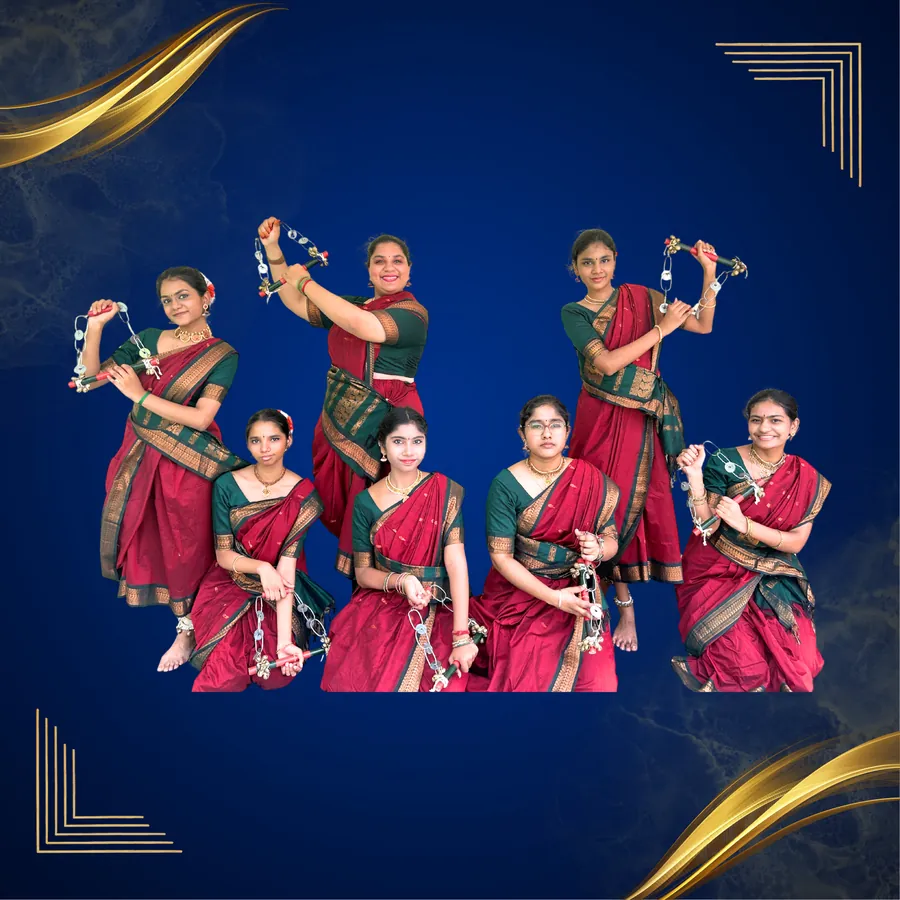
Salangai Kittiyattam did not begin as a dance. In Thanjavur it was how the population was made ready to fight — women and aspiring soldiers alike — a bridge between sport and military training that traditional lore traces to Lord Murugan.

It shares its adavus with Silambattam, but where Silambattam trains the staff, the kitti is a pair of struck wooden sticks standing in for a weapon. Three versions evolved by skill: Sinna Kitti for swordplay, Periya Kitti for the vel, and Salangai Kitti, hung with bells for festival performance and a sharper, more resonant sound.

Salangai Kittiyattam is a rare folk form rooted in the Thanjavur district of Tamil Nadu. It is celebrated today for its rhythmic complexity and communal spirit, but its history is bound up with martial preparedness and the physical conditioning of the general public. It originated as a method of preparing the population, including women and aspiring soldiers, for combat or rigorous physical activity, serving as a bridge between sport and military training. Traditional lore names Lord Murugan as the progenitor of the practice.

It is fundamentally related to Silambattam and shares the same adavus, the fundamental footwork and sequences. Where Silambattam focused on the staff, Kittiyattam used specific wooden instruments to simulate weapon handling. The word kitti refers to that instrument, the name historically derived from the sound of two sticks struck together. It evolved along lines of martial skill into Sinna Kitti for swordplay, Periya Kitti for spear or vel handling, and Salangai Kitti, a specialised version with bells developed for festivals to produce a sharp, resonant sound.

The choice of wood for the kitti traditionally depended on local flora. Tamarind wood was preferred in coastal regions and the thorny Kaarai Mullu shrub inland, though many modern performers use eucalyptus.

As the practice shifted from the training ground to the festival stage it took on rich musical and lyrical traditions, including Kavadi Sindhu style singing, Kummi Paattu, and songs centred on agriculture and social messages. It is characterised by specific rhythmic cycles such as the moonu nadai, a three-beat cycle, and accompanied by traditional instruments including the Nadhaswaram and the Pambai.

In Singapore, Prabanja Aatral Kudil has been actively promoting the art form in recent years. It has been showcased at cultural events, and regular classes are conducted to train aspiring practitioners.

While the core of the tradition remains in Thanjavur, variations exist elsewhere: Kazhiyal Attam is practised in Nagapattinam in a slightly different regional style. It remains a vibrant practice, involving groups of eighty to a hundred people during festivals.

The knowledge passes down through generations by intensive and disciplined training. Students often begin as early as five years old, working through specialised twenty-day training blocks to master the coordination of the kitti with complex footwork.

Sambalpuri

Sambalpuri dancers in handwoven bandha sarees
Sambalpuri dancers · Photo Credits: Bunkar Valley

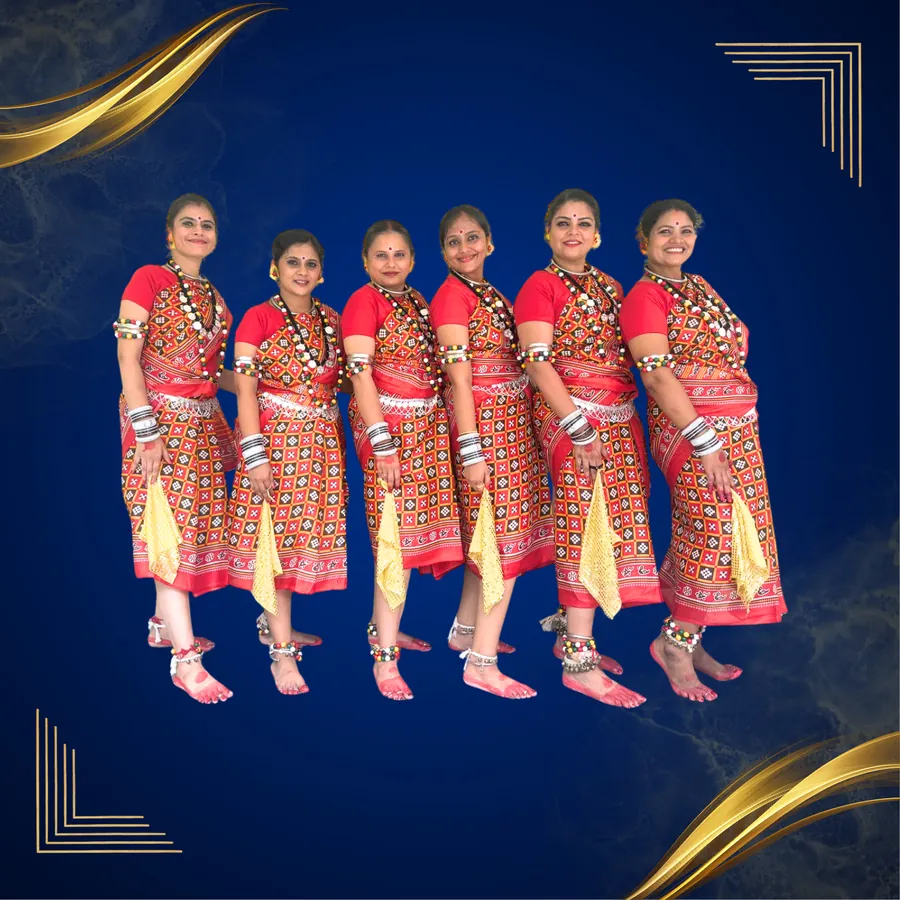
Sambalpuri is not one dance but a family of them, practised by the tribal and rural communities of western Odisha. The name comes from the city of Sambalpur, itself named for Samaleswari, the presiding goddess of the region. The best known of the family is Dalkhai.

Where Dalkhai takes its own name from is contested: a folk deity worshipped as a form of Durga, or the leaves and flowers gathered and offered to her, or simply the refrain — “Dalkhai bo!” — that dancers call out at the opening and close of every stanza. It is danced at Bhai Jiuntia, when sisters worship Durga for their brothers’ wellbeing.

Sambalpuri, meaning “of Sambalpur,” is an umbrella term for a family of folk dances practised by the tribal and rural communities of western Odisha. It is believed to take its name from the city of Sambalpur, itself named for the goddess Samaleswari, the presiding deity of the region.

The most widespread of the Sambalpuri dances, Dalkhai, is said to take its name from a folk deity, Dalkhai Devi, worshipped by communities such as the Mirdha, Kondh, Kuda, Gond and Binjhal as a physical manifestation of the goddess Durga and venerated as a goddess of fertility. An alternative account traces the name instead to dal — the branches, leaves and flowers of trees such as mango, banyan, peepal, gooseberry and hibiscus that are gathered and offered to the deity during her worship. A third and frequently repeated explanation holds that it derives from the refrain “Dalkhai bo!”, an address to a girlfriend called out at the beginning and end of every stanza — a pattern shared by the related dances Rasarkeli and Jaiphula.

Dalkhai is performed on the occasion of Bhai Jiuntia, observed on the eighth day of the bright lunar fortnight of the Odia month of Aswina, when sisters worship Durga for their brothers’ wellbeing, in the districts of Bargarh, Sambalpur, Jharsuguda, Deogarh, Bolangir, Sonepur and Boudh.

No early or medieval textual references to Sambalpuri dance forms comparable to those documented for other regional Odia traditions have been located. The dance appears to survive chiefly through oral transmission, sustained and later documented by twentieth- and twenty-first-century ethnographic scholarship.

Dancers of Dalkhai, Rasarkeli and Jaiphula are typically young unmarried women, dressed in the Sambalpuri saree — a handwoven bandha, or tie-dye, textile in which both the warp and weft threads are resist-dyed before weaving, producing a pattern that reads identically on both faces of the cloth — together with bangles, the katria and bandriya arm ornaments, a nose stud, and a colour scarf draped over the shoulders. The saree and its weaving technique, associated with the Bargarh, Sambalpur, Bolangir and Sonepur districts, were granted Geographical Indication protection by the Government of India in 2012 under the name Sambalpuri Bandha Saree and Fabrics.

The dances are accompanied by a folk orchestra including the dhol, tasha, nishan, tamki and mahuri, sometimes gathered under the name Dulduli, a term also used for an ensemble combining the jhanj, dandua dhol, mandal and mahuri in addition to those above. The songs are sung in the Kosli dialect of Odia, on themes including the love story of Radha and Krishna, episodes from the Ramayana and Mahabharata, and descriptions of the natural landscape.

Beyond the dances performed by young women, the tradition includes:

  • Dalkhai — a ritual dance in honour of Dalkhai Devi, its stanzas opening and closing with the refrain “Dalkhai bo.”
  • Rasarkeli — a similarly paced, romantically themed dance, its stanzas opening with “Rasarkeli bo.”
  • Jaiphula — a dance of courtship and love, its stanzas opening with “Jai phula bo.”
  • Bajnia — a fast-tempo dance performed by the drummers themselves, incorporating acrobatic movement and a combination of punched-together rhythms.

These are danced across the western Odisha festival calendar, including Dussehra, Bhai Jiuntia, Phagun Puni, and Nuakhai, the harvest festival observed on the fifth day of the bright lunar fortnight of Bhadrapada.

There are no official records of when Sambalpuri traditions began in Singapore. Their preservation is spearheaded by diaspora organisations such as the Odia Society of Singapore (SingOdia), which continues the practice through community festivals including Utkal Divas.

Within Odisha, Dalkhai has moved beyond its village-ritual origins into staged and competitive performance, judged at school, college and state-level cultural festivals on synchronisation, choreography and vocal quality — even as its practice among the Binjhal, Kondh, Mirdha and other tribal communities continues alongside that newer, more public life.

The Sambalpuri saree remains a living handloom craft under active state and central government promotion following its 2012 Geographical Indication registration, sustaining the weaving communities on which the dance’s costume depends.

Among the Odia diaspora, including in Singapore, the dance and its music continue to surface at community gatherings marking the calendar of Odisha’s own festivals, carried forward by performers trained in both the folk and classical branches of Odisha’s dance heritage.

  1. “History,” My Sambalpur, n.d. mysambalpur.in
  2. “Culture,” My Sambalpur, n.d. mysambalpur.in
  3. Raghumani Naik, “Dalkhai: A popular folk Dance of Western Odisha,” Journal of Humanities and Social Sciences Studies 2, no. 4 (31 July 2020): 48–55.
  4. Nibedita Nath and Supritee Mishra, “Dalkhai – The Journey from Ritualistic to Popular Folk Dance of Western Odisha,” Third Concept 36, no. 431 (January 2023): 34–37.
  5. “9 folk dances that make Odisha a dancer’s paradise,” Odisha Sun Times, 27 July 2016.
  6. “How to Identify Authentic Sambalpuri Saree — Motifs & History,” Bidyut Fashion, n.d.
  7. “Culture & Heritage,” Sambalpur District, Government of Odisha, n.d.
  8. Nibedita Nath and Supreeti Mishra, “An Exploratory Study on Sambalpuri Dance and Music,” ShodhKosh 5, no. 4 (30 April 2024): 183–195.
  9. “Bhai jiuntia observed in Odisha’s Balangir,” KalingaTV, 24 October 2020.
  10. “Home,” Odia Society of Singapore, n.d. singodia.org

Thudumbattam

துடும்பாட்டம்

Thudumbattam players with the bowl-shaped thudumbu drum
Thudumbattam workshop, 2025 · Photo Credits: ATAM

The thudumbu is a bowl-shaped, single-headed drum thrown in mud, its one face covered with buffalo hide, struck with two sticks cut from arali — oleander — bark. It is hung at the waist or held between the legs.

The word is believed to come from the Thudumbars, an indigenous community of the Kongu region. They used the instrument to ward off wild animals when descending the hills they lived in, and played it when sending villagers off on hunts.

The word thudumbu is believed to have originated from the Thudumbars, an indigenous tribal community living in the Kongu region of Tamil Nadu — modern-day Coimbatore, Erode and Salem. It was used to ward off wild animals when descending the hilly regions in which they generally lived, and played when sending villagers off on animal hunts. It is also believed that the instrument is played before opening the sanctum doors of Lord Shiva, to ward off any snakes or other animals that may have entered, and to awaken the divine spirit. The instrument has also become part of Thambolam Melam performances in Kerala.

The thudumbu may also be related to the murasu, a relatively larger traditional drum used on battlefields to signal attacks and for royal announcements from the palace, and a popular symbol of valour. The murasu is referenced in the Purananuru and the Silappathikaram. Three types are well known:

  • Veera murasu — used to announce battle.
  • Niyaya murasu — used in court to beckon the plaintiff, defendant or witnesses.
  • Thiyaga murasu — used when giving gifts or inviting the poor.

Of these it is the veera murasu that is said to be most closely related to the thudumbu.

The thudumbu is the main element of the art form: a bowl-shaped single-headed membranophone made of mud, its single face covered with buffalo hide. It is usually hung over the performer’s waist or held between the legs, and played mostly by men. Two sticks, one in each hand, strike the face to produce a bass sound; they are typically made from arali (oleander) bark.

The thudumbu is commonplace during temple festivities and deity processions, almost ubiquitous in the Kovai region. It also accompanies Jikkattam, and features in Jamab, another Kongu region dance in which performers stand in rows and wave coloured scarves.

Men wear anklets on both feet and the traditional vetti, a long white bordered cloth usually bunched at the knees to allow placement of the drum. Alongside the thudumbu the ensemble carries the uruttu, a smaller single-headed instrument made of calf hide, and the thalava, a pair of small metal cymbals used traditionally as a metronome. The nagari, a larger, heavier drum similar to the thudumbu, is played along with them. It is performed with little to no lyrics, sometimes punctuated by shouts.

There are no official records as to when Thudumbattam traditions began in Singapore. It was featured in ATAM’s Anandha Kondaattam 2024 and introduced as a workshop in the Nam Marabu Series 2025.

Initially male-dominated, more women are seen picking up the art form. Along with the traditional percussion, maracas are sometimes featured in the ensemble.

Urumi Melam

உறுமி மேளம்

Urumi Melam players in procession
Urumi Melam · Photo Credits: ATAM

The urumi is an hourglass drum with two faces, and it does not strike so much as moan. The player hits the left head with a small curved rattan stick while rubbing the right head with a larger bent one, producing a deep, resonant growl. Castor oil sharpens it. The Tamil name is thought to come from that sound.

The urumi is a membranophone with two faces that produces a growl-like sound. By one mythology it was created by the celestial architect Viswakarma.

The earliest official record of the instrument appears to be sixteenth- to seventeenth-century CE: a stone statue of a man playing the urumi drum, recovered from the Karur archaeological dig.

The urumi is traditionally believed to possess sacred and celestial powers, especially when played during temple processions and ritual ceremonies. Its sound is often associated with inducing spiritual possession or trance states. It is commonly found in Tamil-speaking villages and along the Tamil Nadu–Kerala border.

Two main ensembles involve the urumi:

  • Urumi Melam — typically performed at funerals and sombre occasions. One to three urumi drums, accompanied by two pambai drums and the nadaswaram. It often accompanies the funeral lament, or Oppaari.
  • Naiyandi Melam — played at ritual celebrations and dance performances. Two nadaswarams, a thavil, pambai and urumi, creating a richer and more festive soundscape.

Its two faces are cowhide, on a jackwood body shaped like an hourglass. It is slung from the player on a leather, nylon or cloth strap, and often played standing or walking in procession.

Compositions typically draw on two of five foundational Tamil folk rhythmic patterns:

  • Kuthirai adi — “horse beat,” duple, a gentle sway mimicking a horse’s gallop.
  • Rettai adi — also duple, more dynamic and vigorous, with a stronger swinging pulse.
  • Classic adi — duple, influenced by Tamil popular and film music.
  • Moonu adi — triple, comparable to 6/8 in Western music, though its driving momentum can read as duple.
  • Othai adi — emphasises every beat individually, lacking the swing of the others.

Ensembles usually begin with a Ganesha song before moving on to devotional songs about other deities such as Murugan and Hanuman. It is a male-dominated art form.

The urumi is said to have appeared in Ipoh in the 1980s and become popular in Singapore in the early twenty-first century. It is commonly played during Thaipusam, Vesak Day, Panguni and Pongal festivities, and at temple chariot processions.

CDs and DVDs of popular olden-day Tamil folk songs serve as a source of learning for some groups here. There are more than forty urumi groups in Singapore.

Customised urumis with elaborate drawings, paintings or carvings on the body can be seen today. Construction has evolved to improve sound: goat hide is now preferred over cowhide for a more refined tone, and balloon sticks sometimes replace traditional rattan, offering greater flexibility and control.

Groups sometimes borrow rhythmic patterns from other cultures — the Chinese lion dance, or Bhangra — when collaborating with those communities. There is also a practice of converting non-religious songs into devotional hymns, preserving the tune and changing the lyrics. The terms urumi melam and naiyandi melam have become more interchangeable.

Urumi has found a strong footing in Singapore through its association with religious and ritual practice such as Kavadi, and because it continues to evolve.

Chapter 06

The Music of the Night

ஊரெல்லாம் கும்மி அடிக்க

Oorellam Kummi Adikka

A vibrant celebration of agrarian joy, capturing the lively spirit of a community uniting in harmony for the harvest festival.

  1. ஊரெல்லாம் கும்மி அடிக்க நம்மூருக்குள்ள

    Ūrellām kummi aṭikka nammūrukkuḷḷa

    Clapping our hands as we gather around, right here in our town

  2. ஒய்யாரத் திருவிழாவாம் ஏலேலோலேலம்

    Oyyārat tiruviḻāvām ēlēlōlēlam

    Grand is the festival starting right now, elelolelam

  3. ஒய்யாரத் திருவிழாவில் நம்மூருக்குள்ள

    Oyyārat tiruviḻāvil nammūrukkuḷḷa

    Grand is the festival starting right now, right here in our town

  4. ஒசரமா ரங்கராட்டினம் ஏலேலோலேலம்

    Osaramā raṅkarāṭṭiṉam ēlēlōlēlam

    Ferris wheels spinning so high in the sky, elelolelam

  5. ஒசரமா ராட்டினத்துல நம்மூருக்குள்ள

    Osaramā rāṭṭiṉattula nammūrukkuḷḷa

    Ferris wheels spinning so high in the sky, right here in our town

  6. உற்சாகமாகச் சுத்துவோம் ஏலேலோலேலம்

    Uṟcākamākac cuttuvōm ēlēlōlēlam

    Joyfully going around and around, elelolelam

  7. உற்சாகமாகச் சுத்தியே நம்மூருக்குள்ள

    Uṟcākamākac cuttiyē nammūrukkuḷḷa

    Joyfully going around and around, right here in our town

  8. ஒத்துமையாக வாழுவோம் ஏலேலோலேலம்

    Ottumaiyāka vāḻuvōm ēlēlōlēlam

    Living in unity, bound as one crowd, elelolelam

  9. விடிகால ஏருபூட்டுனோம் நம்மூருக்குள்ள

    Viṭikāla ērupūṭṭuṉōm nammūrukkuḷḷa

    Yoking the plows at the break of the dawn, right here in our town

  10. வெரசா வயலில் ஓட்டுனோம் ஏலேலோலேலம்

    Veracā vayalil ōṭṭuṉōm ēlēlōlēlam

    Swiftly we drive through the fields we have grown, elelolelam

  11. வெரசா வயலில் ஓட்டியே நம்மூருக்குள்ள

    Veracā vayalil ōṭṭiyē nammūrukkuḷḷa

    Swiftly we drive through the fields we have grown, right here in our town

  12. வெத நெல்லு போட்டு வெதச்சோம் ஏலேலோலேலம்

    Veta nellu pōṭṭu vetaccōm ēlēlōlēlam

    Casting the seeds that we carefully sow, elelolelam

  13. வெதநெல்லு நாத்து விடத்தான் நம்மூருக்குள்ள

    Vetanellu nāttu viṭattāṉ nammūrukkuḷḷa

    Waiting for seedlings to sprout and to grow, right here in our town

  14. வரப்போட நட்டுப்புட்டோமே ஏலேலோலேலம்

    Varappōṭa naṭṭuppuṭṭōmē ēlēlōlēlam

    Planting them deep on the ridges we know, elelolelam

  15. நட்ட நெல்லு மொளைக்கவே நம்மூருக்குள்ள

    Naṭṭa nellu moḷaikkavē nammūrukkuḷḷa

    Watching the seedlings as tall as they grow, right here in our town

  16. பொழுதோட கருதறுத்தமே ஏலேலோலேலம்

    Poḻutōṭa karutaṟuttamē ēlēlōlēlam

    Reaping the harvest before the sun's low, elelolelam

  17. அறுத்த கருத்தடிச்சுத்தான் நம்மூருக்குள்ள

    Aṟutta karuttaṭicuttāṉ nammūrukkuḷḷa

    Threshing the bundles we carefully mow, right here in our town

  18. கொண்டாடப் பொங்கலும் வெச்சோம் ஏலேலோலேலம்

    Koṇṭāṭap poṅkalum veccōm ēlēlōlēlam

    Cooking the pongal to put on a show, elelolelam

  19. கொண்டாட்டப் பொங்கலுக்குத்தான் நம்மூருக்குள்ள

    Koṇṭāṭṭap poṅkalukkuttāṉ nammūrukkuḷḷa

    Feasting on pongal and letting it glow, right here in our town

  20. கூத்தாட வாருங்க இப்போ ஏலேலோலேலம்

    Kūttāṭa vāruṅka ippō ēlēlōlēlam

    Come and join in for the dance we will show, elelolelam

  21. கூத்தாடிச் சாமி கும்பிட்டு நம்மூருக்குள்ள

    Kūttāṭic cāmi kumpiṭṭu nammūrukkuḷḷa

    Dancing and praying to gods that we know, right here in our town

  22. கலையோட ஒண்ணா வாழுவோம் ஏலேலோலேலம்

    Kalaiyōṭa oṇṇā vāḻuvōm ēlēlōlēlam

    Living as one with the arts we bestow, elelolelam

  23. கலைதானே நம்ம சொத்தெல்லாம் நம்மூருக்குள்ள

    Kalaitāṉē namma cottellām nammūrukkuḷḷa

    Art is the wealth that our ancestors sow, right here in our town

  24. காப்பாத்தி நல்லா வாழுவோம் ஏலேலோலேலம்!

    Kāppātti nallā vāḻuvōm ēlēlōlēlam!

    Guarding it well as we live and we grow, elelolelam!

  25. தன்னானே தானே தன்னானே

    Taṉṉāṉē tāṉē taṉṉāṉē

    Thannaane thaane thannaane

  26. தன்னானே தானே

    Taṉṉāṉē tāṉē

    Thannaane thaane

  27. தன்னானே தானே தன்னானே!

    Taṉṉāṉē tāṉē taṉṉāṉē!

    Thannaane thaane thannaane!

ஏய் அடிடா!

Hey Adidaa!

A dynamic tribute to traditional martial arts, echoing the virtues of discipline, courage and the noble pursuit of self-defence.

  1. தன்னானே தன்னானே தன்னானே தானா

    Taṉṉāṉē taṉṉāṉē taṉṉāṉē tāṉā

    Thannaane thannaane thannaane thaanaa

  2. தன்னானே தன்னானே தன்னானே தானா

    Taṉṉāṉē taṉṉāṉē taṉṉāṉē tāṉā

    Thannaane thannaane thannaane thaanaa

  3. எடது பக்கம் வலது பக்கம் எடுத்து வீசி அடிடா

    Eṭatu pakkam valatu pakkam eṭuttu vīci aṭiṭā

    Swing to the left and then swing to the right, take it and strike now, boy!

  4. ஒனக்கு பக்கம் எனக்கு பக்கம் ஓங்கி எடுத்து அடிடா

    Oṉakku pakkam eṉakku pakkam ōṅki eṭuttu aṭiṭā

    Your side and my side, just aim with your might, raise it and strike now, boy!

  5. தனக்கு தன்னா தனக்கு தன்னா தாளம் ஒண்ணு புடிடா

    Taṉakku taṉṉā taṉakku taṉṉā tāḷam oṇṇu puṭiṭā

    Thanakku thanna thanakku thanna, catch the beat and hold it, boy!

  6. சக்கை யாட்டம் ஆடிக்கிட்டே தற்காப்புக்குப் படிடா!

    Cakkai yāṭṭam āṭikkiṭṭē taṟkāppukkup paṭiṭā!

    Dancing the Sakkai and learning to fight, guard yourself bold, my boy!

  7. ஏ! அடிடா அடிடா.. எடுத்துப் புடிடா படிடா!

    Ē! Aṭiṭā aṭiṭā.. eṭuttup puṭiṭā paṭiṭā!

    Yeah! Strike now, strike now.. take it and catch it and learn!

  8. ஏ! அடிடா அடிடா.. எடுத்துப் புடிடா படிடா!

    Ē! Aṭiṭā aṭiṭā.. eṭuttup puṭiṭā paṭiṭā!

    Yeah! Strike now, strike now.. take it and catch it and learn!

  9. வீரமுன்னா வெளையாட்டு சொல்லிக்கிட்டே பழகு

    Vīramuṉṉā veḷaiyāṭṭu collickiṭṭē paḻaku

    Bravery means it's a game that we play, learn it with every turn.

  10. வீணான சண்டை எல்லாம் தேவையில்ல வெலகு

    Vīṇāṉa caṇṭai ellām tēvaiyilla velaku

    Useless and meaningless fights in the way, leave them and step away.

  11. மானமுன்னா உசுரவிடும் ரோசம்நம்ம அழகு

    Māṉamuṉṉā ucuraviṭum rōcamnamma aḻaku

    Honor means giving your life for the pride, that is our beauty's core.

  12. மத்ததெல்லாம் அப்புறம்தான் தேவ இங்க துணிவு

    Mattatellām appuramṭāṉ tēva iṅka tuṇivu

    Everything else is just kept to the side, courage is needed more.

  13. ஏ பழகு! வெலகு! ரொம்ப அழகு துணிவு!

    Ē paḻaku! Velaku! Rompa aḻaku tuṇivu!

    Yeah, learn it! Leave it! Courage is beautiful, see!

  14. ஏ பழகு! வெலகு! ரொம்ப அழகு துணிவு!

    Ē paḻaku! Velaku! Rompa aḻaku tuṇivu!

    Yeah, learn it! Leave it! Courage is beautiful, see!

உருமி உருமி

Urumi Urumi

A stirring anthem of resilience and kinetic energy, highlighting the unwavering bravery required to stand tall and earn the respect of the village.

  1. உருமி உருமி - நல்லா ஒலிக்க ஒலிக்க

    Urumi urumi - nallā olikka olikka

    Urumi, Urumi - sound it out loud, make it clear!

  2. திமிறு திமிறு காள திமிலு கனக்க

    Timiṟu timiṟu kāḷa timilu kaṉakka

    Vigor, oh vigor - heavy the bull's hump is here!

  3. கொம்பச் சீவு-பகைய நின்னு ஜெயிக்க

    Kompac cīvu-pakaiya niṉṉu jeyikka

    Sharpen the horn now - stand at your foes and prevail!

  4. வளைஞ்சு நெளிஞ்சு போயி வெற்றி கெடைக்க

    Vaḷaiñcu neliñcu pōyi veṟṟi keṭaikka

    Bending and twisting - winning without any fail!

  5. ஏறு ஏறு - முன்ன சீரு சீரு

    Ēṟu ēṟu - muṉṉa cīru cīru

    Climb up, oh climb up - charge at the front like a spear!

  6. கூரு கூரு - அதுதான் நிக்கும் பாரு

    Kūru kūru - atutāṉ nikkum pāru

    Sharpness, oh sharpness - look how it stands without fear!

  7. சிங்கம் புலிதான் எதிர வந்தா என்ன?

    Ciṅkam pulitāṉ etira vantā eṉṉa?

    What if the tiger and lion appear in your sight?

  8. கொம்ப யான தனியா நிக்கும் பாரு

    Kompa yāṉa taṉiyā nikkum pāru

    Look how the elephant's tusk stands alone in the fight!

  9. நேரமது வந்துப்புட்டா வெற்றி உன்ன தேடிவரும்

    Nēramatu vantuppuṭṭā veṟṟi uṉṉa tēṭivarum

    When the time comes, then the victory seeks out your name.

  10. வீரமுன்னு ஊருக்காக நின்னுபாரு பேருவரும்

    Vīramuṉṉu ūrukkāka niṉṉupāru pēruvarum

    Stand for the village with bravery, bringing you fame.

  11. எப்பவுமே நம்மதலை நிமிந்திருக்கும் துணிவழகு

    Eppavumē nammatalai nimintirukkum tuṇivaḻaku

    Always our heads are held high, and our courage is grand.

  12. எதிர்ப்பவனும் ரசிச்சுப்புட்டா நம்மவீரம் பேரழகு

    Etirppavaṉum raciccuppuṭṭā nammavīram pēraḻaku

    Even our foes will admire our brave-hearted band.

  13. ஒன்னப்போல பலசாலி ஊருக்குள்ள யாருமில்ல

    Oṉṉappōla palacāli ūrukkuḷḷa yārumilla

    There is no strongman like you in the village around.

  14. நம்மவூர் சனமெல்லாம் தொணையிருக்கு அச்சமில்ல

    Nammavūr caṉamellām toṇaiyirukku accamilla

    All of our people are with you, no fear to be found.

  15. சண்டபோட்டு நின்னாத்தான் வீரமுன்னு ஏதுமில்ல

    Caṇṭapōṭṭu niṉṉāttāṉ vīramuṉṉu ētumilla

    Just standing and fighting is never what bravery means.

  16. ஒன்னநீ ஜெயிச்சாலே ஒலகம்வரும் கைக்குவுள்ள

    Oṉṉanī jeyiccālē olakamvarum kaikkuvuḷḷa

    Win over yourself and the world will be in your hands' gleams.

  17. உருமி உருமி - நல்லா ஒலிக்க ஒலிக்க

    Urumi urumi - nallā olikka olikka

    Urumi, Urumi - sound it out loud, make it clear!

  18. திமிறு திமிறு காள திமிலு கனக்க

    Timiṟu timiṟu kāḷa timilu kaṉakka

    Vigor, oh vigor - heavy the bull's hump is here!

என் ராசாவே

Yen Raasave

A deeply moving traditional lament honouring the sacrifices of agricultural workers, expressing profound grief over the loss of those who devoted their hands to the soil.

  1. வானம் மழையடிச்சு... என் ராசாவே

    Vāṉam maḻaiyaṭiccu... eṉ rācāvē

    Skies have poured down the rain... oh, my sweet king,

  2. மண்ணு மணந்துருச்சே

    Maṇṇu maṇanturuccē

    Earth is now smelling sweet.

  3. மண்ணு மணந்தாலும்... என் ராசாவே

    Maṇṇu maṇantālum... eṉ rācāvē

    Though the earth smells so sweet... oh, my sweet king,

  4. மனசு புழுங்குதய்யா

    Maṉacu puḻuṅkutayyā

    My heart is boiling in heat.

  5. மேகம் இடியிடிச்சு... என் ராசாவே

    Mēkam iṭiyiṭiccu... eṉ rācāvē

    Clouds crashed with thunder loud... oh, my sweet king,

  6. முத்து மழை பெஞ்சுருச்சே

    Muttu maḻai peñcuruccē

    Pearls of rain falling down.

  7. பெய்யும் மழைக்கணக்கா... என் ராசாவே

    Peyyum maḻaikkaṇakkā... eṉ rācāvē

    Just like the pouring rain... oh, my sweet king,

  8. கண்ணு அழுகுதய்யா

    Kaṇṇu aḻukutayyā

    Tears from my eyes now drown.

  9. காத்து பொயக்காத்து... என் ராசாவே

    Kāttu poyakkāttu... eṉ rācāvē

    Winds blew a hollow breeze... oh, my sweet king,

  10. காட்ட கலக்கிடுச்சே

    Kāṭṭa kalakkiṭuccē

    Stirring the forest deep.

  11. காடே கலங்கக் கண்டு.... என் ராசாவே

    Kāṭē kalaṅkak kaṇṭu.... eṉ rācāvē

    Seeing the forest shake... oh, my sweet king,

  12. நெஞ்சம் பதைக்குதையா

    Neñcam pataikkutaiyā

    My trembling heart starts to weep.

  13. மண்ணீரம் காங்காம... என் ராசாவே

    Maṇṇīram kāṅkāma... eṉ rācāvē

    Before the earth could dry... oh, my sweet king,

  14. மலையொண்ணு சாஞ்சிருச்சே

    Malaiyoṇṇu cāñciruccē

    A mighty mountain has dropped.

  15. மலையே சாயக்கண்டு.... என் ராசாவே

    Malaiyē cāyakkaṇṭu.... eṉ rācāvē

    Seeing the mountain fall... oh, my sweet king,

  16. கண்ணீரம் பொங்குதையா

    Kaṇṇīram poṅkutaiyā

    Tears from my eyes haven't stopped.

  17. கலப்ப புடிச்ச கையி... என் ராசாவே

    Kalappa puṭicca kayyi... eṉ rācāvē

    Hands that once held the plow... oh, my sweet king,

  18. காளையோட்டி நின்ன கையி

    Kāḷaiyōṭṭi niṉṉa kayyi

    Hands that drove bulls ahead.

  19. உழுது வெதச்ச கையி... என் ராசாவே

    Uḻutu vetacca kayyi... eṉ rācāvē

    Hands that once sowed the seeds... oh, my sweet king,

  20. உசுரில்லாம கெடக்குதையா!

    Ucurillāma keṭakkutaiyā!

    Now lying lifeless and dead!

  21. ஊரு சனமழுக.. என் ராசாவே

    Ūru caṉamaḻuka.. eṉ rācāvē

    Village folks cry for you... oh, my sweet king,

  22. உச்சியில வானழுக

    Ucciyila vāṉaḻuka

    Skies weep from way up high.

  23. உள்ளங் கரைஞ்சழுக.. என் ராசாவே

    Uḷḷaṅ karaiñcaḻuka.. eṉ rācāvē

    Hearts melting as we cry... oh, my sweet king,

  24. ஊரவிட்டுப் போறியளா....

    Ūraviṭṭup pōṟiyaḷā....

    Leaving the town, you fly...

  25. ஒறவவிட்டுப் போறியளா... என் ராசாவே

    Oṟavaviṭṭup pōṟiyaḷā... eṉ rācāvē

    Leaving your kin behind... oh, my sweet king,

  26. ஒடல விட்டுப் போறியளா...

    Oṭala viṭṭup pōṟiyaḷā...

    Leaving your body too...

  27. உடம விட்டு போறியளா... என் ராசாவே

    Uṭama viṭṭu pōṟiyaḷā... eṉ rācāvē

    Leaving your wealth behind... oh, my sweet king,

  28. உசுரவிட்டுப் போறியளா!... ஒங்க

    Ucuraviṭṭup pōṟiyaḷā!... oṅka

    Are you leaving your life too!... oh,

  29. உசுரவிட்டுப் போறியளா!

    Ucuraviṭṭup pōṟiyaḷā!

    Are you leaving your life too!

ஊரான ஊருக்குள்ள

Oorana Oorukulla

An inspiring journey across diverse landscapes, invoking a shared sense of harmony, unity and optimism for all humanity.

  1. தந்தனக்கு தந்தனக்கு தனக்கு தந்தானே

    Tantaṉakku tantaṉakku taṉakku tantāṉē

    Thanthanakku thanthanakku thanakku thanthaane

  2. தனக்கு தனக்கு தன தினக்கு தில்லாலே

    Taṉakku taṉakku taṉa tiṉakku tillālē

    Thanakku thanakku thana thinakku thillaale

  3. ஊரான ஊருக்குள்ள தனக்குத் தந்தானே

    Ūrāṉa ūrukkuḷḷa taṉakkut tantāṉē

    Of all the towns in the land, thanakku thanthaane,

  4. எங்கூரு தனியூரு தினக்கு தில்லாலே

    Eṅkūru taṉiyūru tiṉakku tillālē

    Our town stands out so grand, thinakku thillaale.

  5. ஒய்யார ஒலகத்துல தனக்குத் தந்தானே

    Oyyāra olakattula taṉakkut tantāṉē

    In this whole beautiful world, thanakku thanthaane,

  6. ஒசந்தூரு எங்கூரு தினக்கு தில்லாலே

    Osantūru eṅkūru tiṉakku tillālē

    Our town's the highest pearl, thinakku thillaale.

  7. மலையூரு கடலூரு தனக்குத் தந்தானே

    Malaiyūru kaṭalūru taṉakkut tantāṉē

    Mountain towns, coastal towns, thanakku thanthaane,

  8. மச்சூரு மேட்டூரு தினக்கு தில்லாலே

    Maccūru mēṭṭūru tiṉakku tillālē

    Highland and lowland towns, thinakku thillaale.

  9. தலையூரு தமிழூரு தனக்குத் தந்தானே

    Talaiyūru tamiḻūru taṉakkut tantāṉē

    Capital towns, Tamil towns, thanakku thanthaane,

  10. தெக்கூரு மேக்கூரு தினக்கு தில்லாலே

    Tekkūru mēkkūru tiṉakku tillālē

    Southern and western towns, thinakku thillaale.

  11. மாடுகட்டி போரடிச்சா தனக்கு தந்தானே

    Māṭukaṭṭi pōraṭiccā taṉakku tantāṉē

    If cows get tired of the plow, thanakku thanthaane,

  12. பத்தாத வயலூரு தினக்கு தில்லாலே

    Pattāta vayalūru tiṉakku tillālē

    Fields aren't enough for now, thinakku thillaale.

  13. யானகட்டி போரடிச்சு தனக்கு தந்தானே

    Yāṉakaṭṭi pōraṭiccu taṉakku tantāṉē

    Elephants threshing the grain, thanakku thanthaane,

  14. பசியாத்தும் நல்லூரு தினக்கு தில்லாலே

    Paciyāttum nallūru tiṉakku tillālē

    Good town that feeds the plain, thinakku thillaale.

  15. ஆறோடும் வயலோரம் தனக்கு தந்தானே

    Āṟōṭum vayalōram taṉakku tantāṉē

    Rivers run close to the field, thanakku thanthaane,

  16. மானோடும் மலையோரம் தினக்கு தில்லாலே

    Māṉōṭum malaiyōram tiṉakku tillālē

    Deer run on hills concealed, thinakku thillaale.

  17. நதியோட மருந்தோடும் தனக்கு தந்தானே

    Natiyōṭa maruntōṭum taṉakku tantāṉē

    Medicine flows with the stream, thanakku thanthaane,

  18. வீட்டோட வரப்போடும் தினக்கு தில்லாலே

    Vīṭṭōṭa varappōṭum tiṉakku tillālē

    Ridges by homes that gleam, thinakku thillaale.

  19. ஆடுமாடு கோழிகளும் தனக்கு தந்தானே

    Āṭumāṭu kōḻikaḷum taṉakku tantāṉē

    All of the cattle and hens, thanakku thanthaane,

  20. அத்தனையும் நம்மஎனம் தினக்கு தில்லாலே

    Attaṉaiyum namma'eṉam tiṉakku tillālē

    They are our kindred friends, thinakku thillaale.

  21. நாடெல்லாம் மனுசகொலம் தனக்கு தந்தானே

    Nāṭellām maṉucakolam taṉakku tantāṉē

    All of the human race, thanakku thanthaane,

  22. ஒத்துமையா வாழும்நெலம் தினக்கு தில்லாலே

    Ottumaiyā vāḻumnelam tiṉakku tillālē

    Lives in this peaceful space, thinakku thillaale.

  23. ஒருவூரு மட்டுமில்ல தனக்கு தந்தானே

    Oruvūru maṭṭumilla taṉakku tantāṉē

    It isn't just one single town, thanakku thanthaane,

  24. ஒலகமே நம்மூரு தினக்கு தில்லாலே

    Olakamē nammūru tiṉakku tillālē

    The whole world is our own ground, thinakku thillaale.

  25. மாடுபூட்டி விட்டாக்கா தனக்கு தந்தானே

    Māṭupūṭṭi viṭṭākkā taṉakku tantāṉē

    Yoking the bulls to the cart, thanakku thanthaane,

  26. வழியெல்லாம் நம்மூரு தினக்கு தில்லாலே

    Vaḻiyellām nammūru tiṉakku tillālē

    Every path is our heart, thinakku thillaale.

  27. சல்லி குலுங்குதடி தனக்கு தந்தானே

    Calli kuluṅkutaṭi taṉakku tantāṉē

    Cowbells are jingling loud, thanakku thanthaane,

  28. காளத் திமில் துள்ளுதடி தினக்கு தில்லாலே

    Kāḷat timil tuḷḷutaṭi tiṉakku tillālē

    Bull humps are bouncing proud, thinakku thillaale.

  29. வண்டி பூட்டிவிடு தனக்கு தந்தானே

    Vaṇṭi pūṭṭiviṭu taṉakku tantāṉē

    Tie up the cart and let's go, thanakku thanthaane,

  30. வழியெல்லாம் நம்மூரு தினக்கு தில்லாலே!

    Vaḻiyellām nammūru tiṉakku tillālē!

    Every path is our home, thinakku thillaale!

  31. அடுத்தூரு எந்தூரு தனக்கு தந்தானே

    Aṭuttūru entūru taṉakku tantāṉē

    What is the very next town? thanakku thanthaane,

  32. ஆதரிக்கும் நல்லூரு தினக்கு தில்லாலே

    Ātarikkum nallūru tiṉakku tillālē

    A good town that helps us crown, thinakku thillaale.

  33. வெளைஞ்சூரு எந்தூரு தனக்கு தந்தானே

    Veḷaiñcūru entūru taṉakku tantāṉē

    What is the harvesting town? thanakku thanthaane,

  34. வெள்ளாம எந்தூரு தினக்கு தில்லாலே

    Veḷḷāma entūru tiṉakku tillālē

    A town where the crops abound, thinakku thillaale.

  35. கட்டவண்டி போறவழி தனக்கு தந்தானே

    Kaṭṭavaṇṭi pōṟavaḻi taṉakku tantāṉē

    Path where the tied cart goes, thanakku thanthaane,

  36. காச்சவூரு எந்தூரு தினக்கு தில்லாலே

    Kāccavūru entūru tiṉakku tillālē

    What is the town that glows? thinakku thillaale.

  37. மயிலுவண்டி போறவழி தனக்கு தந்தானே

    Mayiluvaṇṭi pōṟavaḻi taṉakku tantāṉē

    Path where the peacock cart goes, thanakku thanthaane,

  38. மணந்தூரு எந்தூரு தினக்கு தில்லாலே

    Maṇantūru entūru tiṉakku tillālē

    What is the sweet-smelling rose? thinakku thillaale.

  39. வண்டிகட்டி போறவழி தனக்கு தந்தானே

    Vaṇṭikaṭṭi pōṟavaḻi taṉakku tantāṉē

    Path where the wagon rolls on, thanakku thanthaane,

  40. வாச்சவூரு எந்தூரு தினக்கு தில்லாலே

    Vāccavūru entūru tiṉakku tillālē

    What is the blessed town's dawn? thinakku thillaale.

  41. வாக்கப்பட எந்தூரு தனக்கு தந்தானே

    Vākkappaṭa entūru taṉakku tantāṉē

    Town where we go to be wed, thanakku thanthaane,

  42. வாகான தெந்தூரு தினக்கு தில்லாலே

    Vākāṉa tentūru tiṉakku tillālē

    South town where we are led, thinakku thillaale.

  43. மும்மாரி பெஞ்சிருக்க தனக்கு தந்தானே

    Mummāri peñcirukka taṉakku tantāṉē

    Three kinds of rain having poured, thanakku thanthaane,

  44. முப்போகம் பொன்வெளைய தினக்கு தில்லாலே

    Muppōkam poṉveḷaiya tiṉakku tillālē

    Golden crops are our reward, thinakku thillaale.

  45. ஒப்பான தெந்தூரு தனக்கு தந்தானே

    Oppāṉa tentūru taṉakku tantāṉē

    Which is the town that compares? thanakku thanthaane,

  46. ஓட்டுங்கடா அந்தூரு தினக்கு தில்லாலே!

    Ōṭṭuṅkaṭā antūru tiṉakku tillālē!

    Drive to that town right there, thinakku thillaale!
நம்ம இனம்

Namma Inam

A rhythmic, playful composition celebrating the spirited nature of the community, inviting the audience to engage with the joyous, driving beats.

நம்ம எனம்

Namma eṉam

நல்ல சனம்

Nalla caṉam

நம்ம கொணம்

Namma koṇam

நல்ல தனம்

Nalla taṉam

ஏறுடா

Ēṟuṭā

அடிச்சேறுடா

Aṭiccēṟuṭā

நாமடா

Nāmaṭā

இனி நாமடா

Iṉi nāmaṭā

தாளம் போடு

Tāḷam pōṭu

மேளம் போடு

Mēḷam pōṭu

நம்ம காலம்

Namma kālam

ஏறி ஆடு!
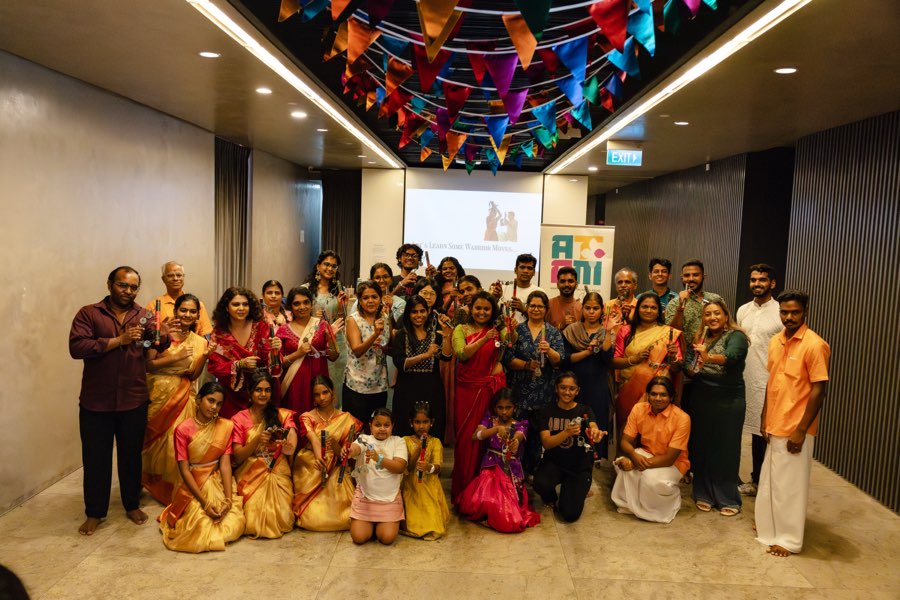
Ēṟi āṭu!
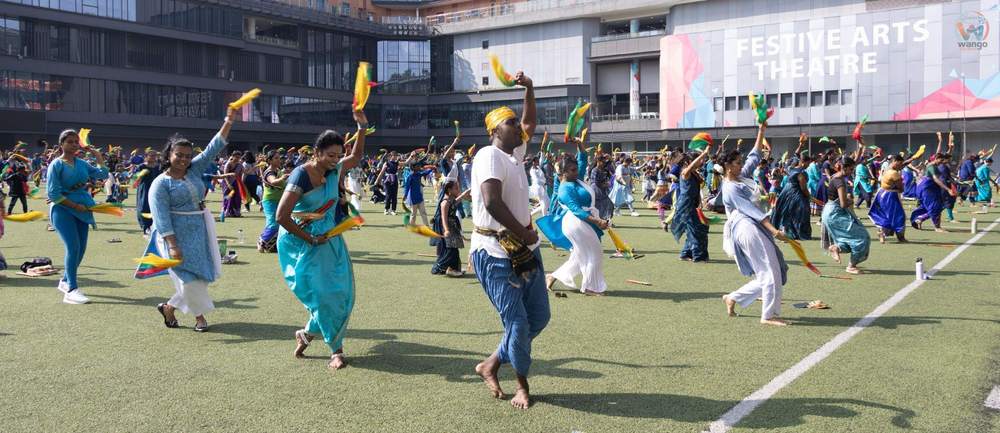
Translation to come

பாட்டாலே

Paattaley

A poetic reflection on how music intertwines with every phase of life and labour, carrying the enduring promise of new hope through rhythm and movement.

  1. பாட்டாலே சுத்துதிந்தப் பூமி (ஏலோ)

    Pāṭṭālē cuttutintap pūmi (ēlō)

    This earth revolves around a song (elo)

  2. பாட்டப்போல சந்தோசம் என்னவுண்டு காமி (ஏலோ)

    Pāṭṭappōla cantōcam eṉṉavuṇṭu kāmi (ēlō)

    Show me what joy is half as strong (elo)

  3. வெளுக்கையில சேவகூவும் பாட்டு (பாட்டு)

    Veḷukkaiyila cēvakūvum pāṭṭu (pāṭṭu)

    Song of the rooster at the break of light (song)

  4. வெதநெலத்த உழுங்காள கழுத்துமணிப் பாட்டு (பாட்டு)

    Vetanelatta uḻuṅkāḷa kaḻuttumaṇip pāṭṭu (pāṭṭu)

    Song of the bells on bulls that plow so right (song)

  5. வெதைக்கையில நாத்துநடும் பாட்டு (பாட்டு)

    Vetaikkaiyila nāttunaṭum pāṭṭu (pāṭṭu)

    Song of the planting when we sow the seed (song)

  6. வெரசாநீர் எறைக்கையிலே ஏத்தநீருப் பாட்டு (பாட்டு)

    Veracānīr eṟaikkaiyilē ēttanīrup pāṭṭu (pāṭṭu)

    Song of the water drawn to meet our need (song)

  7. மாமரத்தில் கிளி பாடும் பாட்டு (பாட்டு)

    Māmarattil kiḷi pāṭum pāṭṭu (pāṭṭu)

    Song of the parrot on the mango tree (song)

  8. மத்தியான வெயிலோட குயில்கூவும் பாட்டு (பாட்டு)

    Mattiyāṉa veyilōṭa kuyilkūvum pāṭṭu (pāṭṭu)

    Song of the cuckoo in the sun so free (song)

  9. தென்னமர அணில்கீச்சும் பாட்டு (பாட்டு)

    Teṉṉamara aṇilkīccum pāṭṭu (pāṭṭu)

    Song of the squirrel on the coconut palm (song)

  10. தேக்குமர எலையோடக் காத்தாடும் பாட்டு (பாட்டு)

    Tēkkumara elaiyōṭak kāttāṭum pāṭṭu (pāṭṭu)

    Song of the wind upon the teak wood's calm (song)

  11. தொட்டிலுக்கு தாலாட்டு பாட்டு (பாட்டு)

    Toṭṭilukku tālāṭṭu pāṭṭu (pāṭṭu)

    Song of the lullaby beside the bed (song)

  12. தொணையோட போகையில நையாண்டி பாட்டு (பாட்டு)

    Toṇaiyōṭa pōkaiyila naiyāṇṭi pāṭṭu (pāṭṭu)

    Song of the teasing when as friends we tread (song)

  13. ஆடவைக்கும் உறுமி மேளப் பாட்டு (பாட்டு)

    Āṭavaikkum uṟumi mēḷap pāṭṭu (pāṭṭu)

    Song of the Urumi that makes us dance (song)

  14. ஆடி அடங்கையில ஒப்பாரிப் பாட்டு (பாட்டு)

    Āṭi aṭaṅkaiyila oppārip pāṭṭu (pāṭṭu)

    Song of the mourning when the end's by chance (song)

  15. முளைப்பாரி சுத்திக் கும்மி பாட்டு

    Muḷaippāri cuttikkummi pāṭṭu (pāṭṭu)

    Song of the clapping round the sprout we praise (song)

  16. (பாட்டு) வெள்ளாம அறுக்கையில குலவையிடும் பாட்டு

    Veḷḷāma aṟukkaiyila kulavaiyiṭum pāṭṭu (pāṭṭu)

    Song of the cheering on the harvest days (song)

  17. (பாட்டு) கல்யாண நலுங்கு வைக்கும் பாட்டு

    Kalyāṇa naluṅku vaikkum pāṭṭu (pāṭṭu)

    Song of the blessing when the weddings start (song)

  18. (பாட்டு) கபடி ஆடும் ஆட்டத்துல மூச்சடக்கும் பாட்டு

    Kapaṭi āṭum āṭṭattula mūccaṭakkum pāṭṭu (pāṭṭu)

    Song of the breath held in the Kabaddi part (song)

  19. (பாட்டு) வண்டியோட்ட தெம்மாங்கு பாட்டு

    Vaṇṭiyōṭṭa temmāṅku pāṭṭu (pāṭṭu)

    Song of the wagon rolling down the track (song)

  20. (பாட்டு) வல்லத்துல துடுப்போட்ட ஏலேலோ பாட்டு

    Vallattula tuṭuppōṭṭa ēlēlō pāṭṭu (pāṭṭu)

    Song of the rowing in the boat out back (song)

  21. (பாட்டு) வழிநடையா எத்தனையோ பாட்டு

    Vaḻinaṭaiyā ettaṉaiyō pāṭṭu (pāṭṭu)

    Songs for the journey on the walking road (song)

  22. (பாட்டு) வலிமறந்து உழச்சிருக்க பாடுமெசப் பாட்டு

    Valimaṟantu uḻaccirukka pāṭumecap pāṭṭu (pāṭṭu)

    Songs sung to heal the pain of labor's load (song)

ஆனந்த கொண்டாட்டம் பொங்குதம்மா

Anandha Kondaattam Pongudhamma

A grand, jubilant celebration of traditional folk performing arts, capturing the pure bliss that arises when all living beings exist together in perfect unity.

  1. தன்னன நாதினம் தன்னன நாதினம்

    Taṉṉaṉa nātiṉam taṉṉaṉa nātiṉam

    Thannana naathinam thannana naathinam

  2. தன்னன நாதினம் தந்தானே

    Taṉṉaṉa nātiṉam tantāṉē

    Thannana naathinam thanthaane

  3. தன்னன நாதினம் தன்னன நாதினம்

    Taṉṉaṉa nātiṉam taṉṉaṉa nātiṉam

    Thannana naathinam thannana naathinam

  4. தன்னன நாதினம் தந்தானே!!

    Taṉṉaṉa nātiṉam tantāṉē!!

    Thannana naathinam thanthaane!!

  5. அன்பு இருக்குற நெஞ்சுக்குள்ள எல்லாம்

    Aṉpu irukkuṟa neñcukkuḷḷa ellām

    Inside the hearts where love is alive

  6. ஆனந்தக் கொண்டாட்டம் பொங்குதம்மா

    Āṉantak koṇṭāṭṭam poṅkutammā

    Joyful celebration bubbles and thrives!

  7. தெம்பு குடுக்குற கலைய ரசிச்சிட

    Tempu kuṭukkuṟa kalaiya racicciṭa

    Watching the art that gives us the drive

  8. ஆனந்தக் கொண்டாட்டம் பொங்குதம்மா

    Āṉantak koṇṭāṭṭam poṅkutammā

    Joyful celebration bubbles and thrives!

  9. நாட்டுப்புறக்கல ஆடும் அழகுல

    Nāṭṭuppuṟakkala āṭum aḻakula

    Folk arts that dance with beauty and pride

  10. ஆனந்தக் கொண்டாட்டம் பொங்குதம்மா

    Āṉantak koṇṭāṭṭam poṅkutammā

    Joyful celebration bubbles and thrives!

  11. மேலும் இந்தக்கலை வாழும் எனச்சொல்ல

    Mēlum intakkalai vāḻum eṉaccolla

    Saying this art will live and survive

  12. ஆனந்தக் கொண்டாட்டம் பொங்குதம்மா

    Āṉantak koṇṭāṭṭam poṅkutammā

    Joyful celebration bubbles and thrives!

  13. மனுஷப் பயமட்டும் இல்ல உலகத்தில்

    Maṉuṣap payamaṭṭum illa ulakattil

    Not only humans live on this earth

  14. அத்தனை உசுரும் ஒத்துமையா

    Attaṉai ucurum ottumaiyā

    All living souls united from birth

  15. ஒண்ணா இருப்பத நின்னு ரசிச்சிட

    Oṇṇā iruppata niṉṉu racicciṭa

    Seeing them stand as one in their worth

  16. ஆனந்தக் கொண்டாட்டம் பொங்குதம்மா

    Āṉantak koṇṭāṭṭam poṅkutammā

    Joyful celebration bubbles and thrives!

  17. எல்லாம் ஒறவுன்னு கேக்குறப்போ இங்க

    Ellām oṟavuṉṉu kēkkuṟappō iṅka

    When we can see that everyone's kin

  18. எல்லாரும் ஒண்ணாகப் பாக்குறப்போ

    Ellārum oṇṇākap pākkuṟappō

    When we see all as equals within

  19. தன்ன மறந்திந்த மக்க மனசுல

    Taṉṉa maṟantinta makka maṉacula

    Hearts of the people forgetting themselves

  20. ஆனந்தக் கொண்டாட்டம் பொங்குதம்மா

    Āṉantak koṇṭāṭṭam poṅkutammā

    Joyful celebration bubbles and thrives!

  21. நேத்து நடந்தத நாள் நடப்பத

    Nēttu naṭantata nāḷ naṭappata

    Things of the past and things of today

  22. இன்னைக் கெதுக்குங்க யோசிக்கணும்

    Iṉṉaik ketukkuṅka yōcikkaṇum

    What comes tomorrow, think of the way

  23. கையில் கிடைச்சத கொண்டு சிரிச்சிட

    Kaiyil kiṭaiccata koṇṭu ciricciṭa

    Laugh with whatever is yours today

  24. ஆனந்தக் கொண்டாட்டம் பொங்குதம்மா

    Āṉantak koṇṭāṭṭam poṅkutammā

    Joyful celebration bubbles and thrives!

  25. ஒத்த ஒலகத்தில் ஒத்த இனமுன்னு

    Otta olakattil otta iṉamuṉṉu

    One single world and one single race

  26. மொத்த உசுரையும் நாமணைச்சு

    Mottta ucuraiyum nāmaṇaiccu

    Holding all lives in a warm embrace

  27. ஒத்துமையா வாழும் நாளும் வருகையில்

    Ottumaiyā vāḻum nāḷum varukaiyil

    When a united day takes its place

  28. ஆனந்தக் கொண்டாட்டம் பொங்குதம்மா

    Āṉantak koṇṭāṭṭam poṅkutammā

    Joyful celebration bubbles and thrives!

  29. பாட்டுக் கலைகள கேக்குறப்போ, உள்ள

    Pāṭṭuk kalaikaḷa kēkkuṟappō, uḷḷa

    When listening to the arts and the song, inside

  30. ஆனந்தக் கொண்டாட்டம் பொங்குதம்மா

    Āṉantak koṇṭāṭṭam poṅkutammā

    Joyful celebration bubbles and thrives!

  31. கேக்குற கைகாலு ஆடுறப்போ, நெஞ்சில்

    Kēkkuṟa kaikālu āṭuṟappō, neñcil

    When hands and legs are dancing along, inside

  32. ஆனந்தக் கொண்டாட்டம் பொங்குதம்மா

    Āṉantak koṇṭāṭṭam poṅkutammā

    Joyful celebration bubbles and thrives!

  33. மேளம் ஒலிச்சிட தாளம் ஒலிச்சிட

    Mēḷam olicciṭa tāḷam olicciṭa

    Beating the drums and keeping the time

  34. ஆனந்தக் கொண்டாட்டம் பொங்குதம்மா

    Āṉantak koṇṭāṭṭam poṅkutammā

    Joyful celebration bubbles and thrives!

  35. நம்ம மரபு இசைகள கேக்கையில்

    Namma marapu icaikaḷa kēkkaiyil

    Hearing our ancient musical rhyme

  36. ஆனந்தக் கொண்டாட்டம் பொங்குதம்மா

    Āṉantak koṇṭāṭṭam poṅkutammā

    Joyful celebration bubbles and thrives!

  37. தன்னன நாதினம் தன்னன நாதினம்

    Taṉṉaṉa nātiṉam taṉṉaṉa nātiṉam

    Thannana naathinam thannana naathinam

  38. தன்னன நாதினம் தந்தானே

    Taṉṉaṉa nātiṉam tantāṉē

    Thannana naathinam thanthaane

  39. தன்னன நாதினம் தன்னன நாதினம்

    Taṉṉaṉa nātiṉam taṉṉaṉa nātiṉam

    Thannana naathinam thannana naathinam

  40. தன்னன நாதினம் தந்தானே!!

    Taṉṉaṉa nātiṉam tantāṉē!!

    Thannana naathinam thanthaane!!

Rangabati

This beloved folk classic is a playful and romantic duet that captures the tender dialogue of youthful love, highlighting endearing shyness, deep affection, and the weaving of golden dreams between two sweethearts.

He rangabati re rangabati

Ho rangabati re rangabati - Hey

Rangabati rangabati kanaka lata

Hasi pade kaha lo katha - Hai

Rangabati rangabati kanaka lata

Hasi pade kaha lo katha

Hai go laje laje go laje laje

Eh laje laje go laje laje - Hai

Laje laje nai jauche matha go

Naikara naikara atha - Hey

laje laje nai jauche matha go

Naikara naikara atha

Sapana rajar sapana

Sapana rajar sapana

Ranir tale suta maley

helaantu guthan

Rangabati rangabati

E akhin asichhi

Kete sapana

Eh jibar dhana

Jibar jibana

Gala ratana re - Hai

He akhin asichhi

Kete sapana

Eh jibar dhana

Jibar jiban

gala ratana re

Mane mali mahakana ho

Mane mali mahakana ho

Mane mali mahakana

Aha mor dhana

Kede milana

Chhana chhana hesi mana - Hay

Aha mor dhana

Kede milana

Chhana chhana hesi mana

Diheen khanji gala sangar sarisa

Diheen khanji gala sangar sarisa

Tuhu tuhu mane karey suruta

Rangabati rangabati

He rangabati re rangabati

Ho rangabati re rangabati - Hey

Rangabati rangabati kanaka lata

Hasi pade kaha lo katha - Hai

Rangabati rangabati kanaka lata

Hasi pade kaha lo katha

Hai go laje laje go laje laje

Eh laje laje go laje laje - Hai

Laje laje nai jauche matha go

Naikara naikara atha - Hey

laje laje nai jauche matha go

Naikara naikara atha

Sapana rajar sapana

Sapana rajar sapana

Ranir tale suta maley

helaantu guthan

Rangabati rangabati

He rangabati re rangabati

Ho rangabati re rangabati

He rangabati re rangabati

Ho rangabati re rangabati

He rangabati re rangabati

Ho rangabati re rangabati

Translation

Rangabati, Rangabati

Hey Rangabati, O Rangabati

Ho Rangabati, O Rangabati — hey

Rangabati, golden vine

Why that smile, won’t you tell me why? — hey

Rangabati, golden vine

Why that smile, won’t you tell me why?

Oh so shy, so shy, so shy

Yes so shy, so shy, so shy — hey

So shy, your head bends low

Your lips tremble soft and slow — hey

So shy, your head bends low

Your lips tremble soft and slow

Dreams of a king, dreams of a king

Dreams of a king, dreams of a king

Under the queen’s gentle veil

Pearl garlands softly entwine

Rangabati, Rangabati

Hey Rangabati, O Rangabati

Ho Rangabati, O Rangabati

Hey Rangabati, O Rangabati

Ho Rangabati, O Rangabati

Hey Rangabati, O Rangabati

Ho Rangabati, O Rangabati

Haathaan Choodlo Per Baisa

A Rajasthani Ghoomar song. A bride, bangled and kohl-lined beneath a Jodhpuri veil, dances while the whole world seems to smile with her.

Haathaan choodlo per baisa

Naina kaajal saaryo raaj

Jodhaana ri chunar maathe

Sukh ro sooraj ugyo aaj

Saj dhaj Gauri Ghoomar ghaale

Saaro jag muskaave aaj

Saaro jag muskaave aaj

The bride is adorned with bangles on her hands,

And her eyes are beautifully lined with kohl.

With the traditional Jodhpuri veil upon her head,

It feels as though the sun of happiness has risen today.

Beautifully dressed, Gauri performs the Ghoomar dance,

And the whole world seems to smile today,

Yes, the whole world seems to smile today.

O mhaari Ghoomar chhe narkhaali ae maa

O mhaari Ghoomar chhe narkhaali ae maa

Ghoomar ramba mhe jyaasa

Ho rajri Ghoomar ramba mhe jyaasa

Oh mother, my Ghoomar dance is so graceful and unique.

Oh mother, my Ghoomar dance is so graceful and unique.

I am going to dance the Ghoomar,

Yes, I am going to joyfully dance the royal Ghoomar.

Sakhiyaan saari saj dhaj aayi

Man mein kod samaayo raaj

Prem preet ri ladiyaan goonthe

Hil mil chok puraave raaj

Saj dhaj Gauri Ghoomar ghaale

Saaro jag muskaave aaj

Ho saaro jag muskaave aaj

All the friends have arrived beautifully dressed,

Their hearts filled with excitement and happiness.

They weave together garlands of love and affection,

And together they decorate the courtyard with beautiful patterns.

Beautifully dressed, Gauri performs the Ghoomar dance,

And the whole world seems to smile today,

Yes, the whole world seems to smile today.

Ho mhaane ramta ne kaajal teeki lyaado ae maa

Ho mhaane ramta ne kaajal teeki lyaado ae maa

Ghoomar ramba mhe jyaasa

Ho rajri Ghoomar ramba mhe jyaasa

Oh mother, bring me a little black kohl mark

To protect me while I dance.

Oh mother, bring me a little black kohl mark.

I am going to dance the Ghoomar,

Yes, I am going to joyfully dance the royal Ghoomar.

Baankadli muchhyaan par saapho

Kesariya rang sove aaj

Dekhe gup-chup kuchh na bole

Mand mand muskaave raaj

Aaj Marvan Ghoomar ghaale

Saaro jag muskaave aaj

Saaro jag muskaave aaj

With his proudly curled moustache and traditional turban,

The saffron colour looks splendid on him today.

He watches quietly without saying anything,

And smiles gently to himself.

Today, the Marwari woman performs the Ghoomar,

And the whole world seems to smile today,

Yes, the whole world seems to smile today.

O mhaane Rathoda ri boli pyaari laage ae maa

O mhaane Rathoda ri boli pyaari laage ae maa

Ghoomar ramba mhe jyaasa

Ho rajri Ghoomar ramba mhe jyaasa

Oh mother, I find the Rathore way of speaking so sweet and charming.

Oh mother, I find the Rathore way of speaking so sweet and charming.

I am going to dance the Ghoomar,

Yes, I am going to joyfully dance the royal Ghoomar.

Chapter 07

A Note of Thanks

Folk arts survive by being a way of life, a tribute to our heritage.

Every one of the art forms featured at Anandha Kondaattam is carried by performers who have dedicated their time and effort over several months.

We are grateful for all our participating art groups and choreographers, who came together, spent hours researching and perfecting each art form, to make this magic happen. We thank the families of all our performers, who have supported their endeavour and their journey with us.

To our festival team, which spent countless hours working on each aspect of the production, thank you for your hard work and dedication. To ATAM’s Executive Committee, the festival ecosystem could not have been possible without your commitment. We would also like to thank ATAM advisory board members and festival advisors for their guidance throughout this project.

To our sponsors who believed in our vision, thank you for all your support that has brought our hopes to life. Our community partners are, and have always been, the bedrock of our initiatives, bringing our work and the art forms we honour to various groups of individuals.

We are grateful for our volunteers, who have supported in various aspects of the festival behind the scenes.

We thank you, our audience, for spending your evening with us at one of our key milestones. ATAM is above all a movement, sustained by your support and love.

How to get involved

Chapter 08

With Gratitude

In collaboration with

  • Esplanade, Theatres on the Bay, Singapore

As part of

  • Raga: Moods, Colours, Emotions

Supported by

  • National Arts Council Singapore
  • arts fund
  • Better Everyday by Tote Board
  • High Commission of India, Singapore

Platinum+ Sponsor

  • Borderless Payments

Platinum Sponsor

  • Neelamani Foundation

Sponsors

  • Gayatri Restaurant
  • Haniffa
  • Maestro Productions
  • House Brand

Community Partners

  • Indian Heritage Centre
  • Singapore Chinese Cultural Centre
  • Malay Heritage Centre
  • Umar Pulavar Tamil Language Centre
  • Tamil Murasu
  • Singapore Tamil Society
  • National Library Board
  • Mediacorp
  • SINDA
  • Singapore Khalsa Association

Participating Organisations

  • Darshan Fine Arts
  • Drum Feng
  • Ekaveera Kalaripayattu Academy
  • Ethos Odissi
  • Kuan San Tang Dragon and Lion Dance Troupe
  • Maharashtra Mandal Singapore
  • Makoolam Kalaikoodam
  • Manimaran Creations
  • Nupura Dance Academy
  • Pirabanja Aatral Kudil
  • Rhythm Dance Academy
  • Royalusion
  • Rudram Arts
  • Sakthi Fine Arts
  • Svayambhu Fine Arts
  • Swarna Kala Mandir
  • Temasek Polytechnic Indian Dance
  • Veeramangai Arts Group
  • Veeravel Urumi Melam

Chapter 09

Tell us what you thought

ATAM © 2026 All Rights Reserved
← Back to AK 2026